Showing posts with label Drills. Show all posts

Friday, August 30, 2019

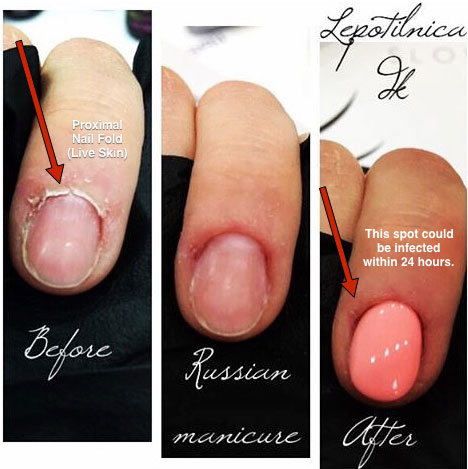
Russian Manicures Part 2 - the Consequences and Experts Weigh In

I mean, seriously, that skin looks raw!
In my first post on Russian Manicures, I discussed a couple different Russian Manicure training videos and broke them down step by step.

In this part 2 of my Russian Manicure post, I will present to you what the experts are saying regarding this technique.

Once again, lets remember throughout this that the Eponychium (actually, we now know this should be called the proximal nail fold (PNF)) is living tissue and should never be cut. From the book "Nanotechnology in Dermatology":
"The skin bordering the proximal nail plate is called the eponychium. It does not end at the nail plate, but instead folds back underneath to create a tight seal which prevents pathogens or contaminants form gaining access to the matrix area... [It] serves to help protect and cushion the matrix. This tissue is often mistakenly confused with the cuticle... The cuticle is a vital part of the seal that protects the matrix from pathogenic invasion, which explains why this area should be treated with care when manicuring."
So, what happens when the "Russian manicure" technique is done on a client? Just like with calluses on feet, the more you cut the PNF , the harder than thicker it will grow back trying to protect itself.

Vitaly Solomonoff, founder and president of the Academy of Nail Art and former editor of Nail Spa magazine in Russia, and his colleagues have studied more than 300 cases of people who have had Russian Manicures. They found that 91% of clients who constantly get the Russian manicure have symptoms of the damaged nail matrix or nail bed. "Only 9% of the cases have been determined as safe and “successful” in a long-term period of study (38 months). All 9% of clients have got the manicure from NTs with basic medical education. So, we come to conclusion that deep understanding of the processes in lively skin helps to train the correct technique of this manicure.... Symptoms may not appear right after manicure is performed, the first symptoms occur months after due the constant repetitive traumatization of the cuticle/matrix area. Symptoms include all signs of matrix/nail dystrophy from splitting, horizontal ridges, slow nail grow to the painful neuropathy and high sensitivity. We have also discovered that infectious inflammations are a common issue in those clients who has compromised immune system – diabetics etc....Imperceptible vibration always takes place even with high end e-files and impacts the highly sensitive matrix area and leads to dramatic postponed issues. The technique that may look safe and easy can bring troubles in the future...We strongly believe that micro cracks of the skin are inseminated with bacteria during few hours after the procedure. "

In addition, Solomonoff has said that "The background of the so called 'Russian manicure' is an attempt of e-files distributors to sell their units in Russia. That is why it has been widely advertised as a safe and 'healthy' alternative to clipping the nail cuticles. We, at my company have always stood against this practice unless NT has at least basic medical education and full understanding of Anatomy and Physiology of the nail unit."


Doug Schoon says "Hopefully, this problem may be self-correcting. When those who use these methods start seeing the reported problems associated with these types of manicures, hopefully they'll wake up and smell the coffee. Excessive damage to the skin around the nail plate, excessive regrowth of hardened callus-like tissue, redness, pain, puffiness, weeping/ water-blisters, itching... these are symptoms I'd expect many will see. Not only can this method cause the expected hardening and rapid/excessive regrowth of tissue, the damaged skin is more likely to develop infections. And, product-related skin irritations or allergies are more likely as well. Invaders beware- watch closely for these issues- and don't blame the products- blame your techniques. I'm already hearing of and seeing these problems."

Whatever, My Clients have had No Problems and LOVE the results

The reason your skin feels "softened" after a Russian Manicure is because the electric file wears away layers of  the epidermis - the very layers that work to keep your skin hydrated - and reveal the new, vulnerable skin underneath - often this can even be the dermis layer of the skin, which is not mean to be exposed to the elements.

Remember, you don't have to bleed in order to suffer damage and damage cannot always be seen by the naked eye. An electric file spins at thousands of revolutions a minute. You can be as light handed as you like but you will still cause damage to the natural nail.

Plus it goes against every principle of good nail health and proper technique.

But, other people are doing it!

And if they were all jumping off a cliff, would you do that too?  

Seriously though, here's the thing - if you are in the United States (and many other countries with regulations on the nail industry), the Russian manicure is a technique that is NOT approved by regulatory agencies nor is it covered under insurance company polices (which means a serious financial risk if you perform the service!). Unregulated countries may be 'allowed' to perform this technique ONLY because there are no licensing requirements or regulations. But even if you can so it doesn't mean you should do it.

Educating your clients about the dangers of the technique and encouraging them to share the knowledge with their friends will help reduce the popularity. Yes, there will still be people who "don't care" and will still seek out the service, but for every person we can educate about the dangers, that is one less person seeking out the service and one less person with damaged nails and skin. We do what we can.

What should we be doing instead?

Regular (preferably weekly) manicures using hydroxy acid based exfoliation products and hydrating masks coupled with a good quality cuticle oil twice a day will take a few weeks but you will see a massive improvement without any mechanical intervention.


References:

https://schoonscientific.com/wp-content/uploads/2017/07/May-17-Doug-Schoon-column.pdf
http://www.newnailcreations.com/links
http://www.salongeek.com/threads/russian-manicure-technique.297841/
https://www.nailcarehq.com/russian-manicure-dangerous/
https://www.nailcarehq.com/the-dangers-of-the-russian-manicure/
https://www.facebook.com/athena.elliott1/posts/10210980427719423


Sunday, May 14, 2017

Russian Manicure Part 1 - Video reviews


If a nail trend has ever given me the willies, its the Russian Manicure (a.k.a combined manicure, Korean manicure, machine manicure). The effect is clean and stunning....and almost always not something that is within scope of a nail tech's license. Having said that, I will say that there are certain parts of the technique that are useful and can be done by a well trained nail tech without damage to the client. But there are other parts of the procedure that literally amount to minor surgery. Lets break this down.


First, a side note. Lets remember throughout this that the eponychium is living tissue and should never be cut. From the book "Nanotechnology in Dermatology":
"The skin bordering the proximal nail plate is called the eponychium. It does not end at the nail plate, but instead folds back underneath to create a tight seal which prevents pathogens or contaminants form gaining access to the matrix area... [It] serves to help protect and cushion the matrix. This tissue is often mistakenly confused with the cuticle... The cuticle is a vital part of the seal that protects the matrix from pathogenic invasion, which explains why this area should be treated with care when manicuring."
Back to our regularly scheduled post:


In the first video, they are using a variety of bits to "clean" the cuticle and eponychium.
  • First, a fine small diamond cylinder bit is used to remove visible cuticle stuck the nail plate. This could be okay, as long as the bit is very fine and care is taken to not over file. There is quite a bit of "dust" on the nail when they do this which is nail plate dust. I don't think that bit is very fine.
  • Second, a needle bit with a blunt edge is used and they instruct you to go "as deep as possible" into the nail grooves. My problem here is that they start pushing under the eponychium to "clean" the cuticle - and in the process are breaking the seal that the eponychium gives to the nail matrix.
  • The third bit is a corundum (stone) bit - which is porous and not disinfectable. You would need to use a new bit for every client. They are using it to smooth the nail plate. This is the third time they have gone over the same area around the sidewalls and eponychium of the nail with a rapidly spinning bit. I don't care how soft the bit is, at this point you are starting to take layers of the nail off.
  • Fourth they use a tiny diamond football (or bullet) to go over again to go even more deeply into the nail folds.
  • A round diamond bit is used to clean raised skin (they keep calling it cuticle but its really living tissue). They also use it to file down the hard, dry skin at the corner of the nails. That makes sense to me, its the same as filing calluses on the feet .

Even worse is the video where they do the same manicure but add scissors. They say that there are 2 instances that you need to use scissors - the first is when your client has "damp cuticle" and is too elastic to get with the machine and the second is for new techs who are not comfortable using the round bit.
  • In this video they show a client with healthy eponychium that is a bit overgrown. They first dry out the moist eponychium with baby powder and then push back the stuck eponychium, (again they keep calling it cuticle, which is wrong)
  • They then use the diamond bit to remove cuticle on the nail plate (which they keep calling pterygium, which is also wrong) and to push up under the eponychum that they pushed back in the first step. Their goal is to raise that eponychium off the nail plate in order to be able to grab it with scissors later. They use the same bit along the sidewalls
  • They powder the skin again to dry it and then use a scissors to cut off the raised eponychium., This is the part where I can't help but cringe.
  • Next they are using a corundum (stone) bit to remove the cuticle that is leftover on the nail plate and smooth the nail plate. Again these bits are porous and not disinfectable.
  • They next use the round diamond bit along the edge where they just cut off the eponychium to further raise the skin "for later cleaning" and then file any raised skin off using the same bit as well as filing down any hard skin on the sides of the nail.
  • They use another corundum (stone) bit to smooth the skin around the nail. 
  • Then they push back the eponychium with a pusher again. How much trauma can this finger withstand??
What are your thoughts on these procedures??

Part 2 of Russian Manicures -  the Consequences and Experts Weigh In coming soon!

Sunday, September 20, 2015

Electric Files

First and foremost, lets make something very clear. A drill is defined as "a hand tool, power tool, or machine with a rotating cutting tip or reciprocating hammer or chisel, used for making holes."  Unless you are planning to drill a hole in your client's nail, please do not use the term "drill" when referring to a professional electric nail file.  [Yes, it is a commonly used term, but it isn't a correct term (like cuticle vs eponychium).]

Electric files emerged in the early 1980s, patterned after tools used in other industries, including the medical and dental fields.  By the mid-1990's electric files had gotten a bad reputation.  Some nail techs seemed deathly afraid of them, saying they were too noisy, they took up too much space, they intimidated clients, and they damaged clients’ nails. Despite their wide use, there didn’t seem to be consistent or widely available information or education on their proper use in the nail salon. It’s not hard to understand why electric files were often misused. Without formal education, the risk of using improper tools or using the right tool the wrong way remained high.

In addition, if a client has had a bad experience with an electric file in the past, explain what you’ll be doing differently. Communication is important during any salon service, and electric files are no exception.

In 1995, Creative Nail Design’s Jan Arnold said she’d do away with electric files entirely if she could. Her biggest criticism was that the files’ vibration and high-speed grinding loosened the acrylic mix before it had a chance to fully cure. That, in turn, led to microscopic cracks that caused breaks and chips in the acrylic nail.  Today, "Creative Nail Design has realized electric files are being widely used in the industry,” says Doug Schoon, vice president of science and technology for Creative Nail Design. “We decided that if they are used correctly they are safe.” The fact that a well-known industry figure who once disapproved of their use is now advocating safe electric file usage says a lot about how far these tools have come.


Lets pause for some Trivia!
TRIVIA QUESTIONS:
Rings of Fire
  1. The metal or rubber bits that hold a sanding band are called ______
  2. Leaving a file bit in disinfection solution for more than _____ at a time can cause it to rust 
  3. Which type of bit produces the LEAST airborne dust ?
  4. You should never use ______ to remove bits from disinfectant solution 
  5. What is a common cause of the bit grabbing the nail?
  6. To reduce the risk of rings of fire, it is recommended that you_____

  7. What is a recommended solution to micro-shattering?
  8. True or False: When a bit is dropped, it should be replaced 
  9. True or False: Pedicure bits are  usually made of carbide 
  10. What is the standard shank size for a salon-grade electric file?
  11. Most nail technicians use electric files with a range of __________
  12. The reverse option on an electric file is needed only for __________
  13. If your hand piece creates excessive vibration, it is recommended that you ________
  14. The standard electric file bits include __________________
  15. Carbide bits are measured by___________
  16. The grooves carved into a client's nail by filing with bits at the incorrect angle are known as___________
  17. _________ bits cannot be effectively disinfected

And now back to our regularly scheduled post...
Steve Wallace, national sales manager of Medicool Inc., in Toronto, California, points out that there is a prevailing motion that electric files will help nail techs do 10 sets a day. Electric files “will help prevent fatigue and can help with carpal tunnel syndrome. And they can reach certain areas that a hand file just can’t. It can help refine their work, but it wasn’t designed to make the process faster.”

Many people still believe an electric file is harmful, but in reality it isn’t what causes damage, it’s the person using it. That is the most common misconception and that’s why education is key. “In my opinion, the greatest single problem plaguing electric files is that people think because they can buy one, they can use it. Until you get formalized training you’re not qualified to use it,” says Schoon. 
It’s like allowing people to buy cars and not teaching them how to drive. Of course when people start driving without getting the proper instructions, they’ll get hurt.

The now defunct Association of Electric File Manufacturers used to teach intensive 8 hour electric file clinics. Even though they no longer exist, the list of topics that they covered in their intensive clinics is a good list for any technician to have under their belt.  Some of these topics include:

  • Types of machines and guidelines for purchasing a machine 
  • The basic techniques of prepping for enhancement products 
  • Upgrading your machine
  • Bit selection and proper use
  • Safety precautions and client protection.
  • Fill-in and maintenance procedures
  • Refining and finishing
  • Using an electric file for manicures and pedicures
  • Pink and white enhancement application and maintenance. 

Kupa has a great play list on how to use various bits on YouTube as does Nail Career Education


-------------------------------------------------------------------------------------------------

TRIVIA ANSWERS:
  1. mandrels 
  2. 10 minutes 
  3. carbide bits 
  4. an un-gloved hand 
  5. improper speed 
  6. reduce the amount of pressure applied during filing and do not hold the bit at an angle to the nail
  7. Use a slower speed, Use a finer grit bit, Make sure the bit is not bent. 
  8. True
  9. False
  10. 1/32"
  11. 5,000 to 20,000 RPM
  12. left-handed nail techs 
  13. have it serviced immediately
  14. carbide bits, diamond bits,  natural nail silicone bits, ceramic bits, sanding bands,  High-shine buffing bits (Chamois or goat hair)
  15. the number of flutes in each bit
  16. rings of fire
  17. High-shine bits (Chamois or goat hair)