Showing posts with label Legal Issues. Show all posts

Friday, August 30, 2019

Russian Manicures Part 2 - the Consequences and Experts Weigh In

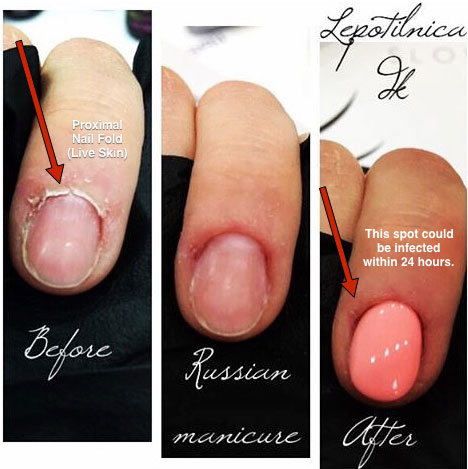
I mean, seriously, that skin looks raw!
In my first post on Russian Manicures, I discussed a couple different Russian Manicure training videos and broke them down step by step.

In this part 2 of my Russian Manicure post, I will present to you what the experts are saying regarding this technique.

Once again, lets remember throughout this that the Eponychium (actually, we now know this should be called the proximal nail fold (PNF)) is living tissue and should never be cut. From the book "Nanotechnology in Dermatology":
"The skin bordering the proximal nail plate is called the eponychium. It does not end at the nail plate, but instead folds back underneath to create a tight seal which prevents pathogens or contaminants form gaining access to the matrix area... [It] serves to help protect and cushion the matrix. This tissue is often mistakenly confused with the cuticle... The cuticle is a vital part of the seal that protects the matrix from pathogenic invasion, which explains why this area should be treated with care when manicuring."
So, what happens when the "Russian manicure" technique is done on a client? Just like with calluses on feet, the more you cut the PNF , the harder than thicker it will grow back trying to protect itself.

Vitaly Solomonoff, founder and president of the Academy of Nail Art and former editor of Nail Spa magazine in Russia, and his colleagues have studied more than 300 cases of people who have had Russian Manicures. They found that 91% of clients who constantly get the Russian manicure have symptoms of the damaged nail matrix or nail bed. "Only 9% of the cases have been determined as safe and “successful” in a long-term period of study (38 months). All 9% of clients have got the manicure from NTs with basic medical education. So, we come to conclusion that deep understanding of the processes in lively skin helps to train the correct technique of this manicure.... Symptoms may not appear right after manicure is performed, the first symptoms occur months after due the constant repetitive traumatization of the cuticle/matrix area. Symptoms include all signs of matrix/nail dystrophy from splitting, horizontal ridges, slow nail grow to the painful neuropathy and high sensitivity. We have also discovered that infectious inflammations are a common issue in those clients who has compromised immune system – diabetics etc....Imperceptible vibration always takes place even with high end e-files and impacts the highly sensitive matrix area and leads to dramatic postponed issues. The technique that may look safe and easy can bring troubles in the future...We strongly believe that micro cracks of the skin are inseminated with bacteria during few hours after the procedure. "

In addition, Solomonoff has said that "The background of the so called 'Russian manicure' is an attempt of e-files distributors to sell their units in Russia. That is why it has been widely advertised as a safe and 'healthy' alternative to clipping the nail cuticles. We, at my company have always stood against this practice unless NT has at least basic medical education and full understanding of Anatomy and Physiology of the nail unit."


Doug Schoon says "Hopefully, this problem may be self-correcting. When those who use these methods start seeing the reported problems associated with these types of manicures, hopefully they'll wake up and smell the coffee. Excessive damage to the skin around the nail plate, excessive regrowth of hardened callus-like tissue, redness, pain, puffiness, weeping/ water-blisters, itching... these are symptoms I'd expect many will see. Not only can this method cause the expected hardening and rapid/excessive regrowth of tissue, the damaged skin is more likely to develop infections. And, product-related skin irritations or allergies are more likely as well. Invaders beware- watch closely for these issues- and don't blame the products- blame your techniques. I'm already hearing of and seeing these problems."

Whatever, My Clients have had No Problems and LOVE the results

The reason your skin feels "softened" after a Russian Manicure is because the electric file wears away layers of  the epidermis - the very layers that work to keep your skin hydrated - and reveal the new, vulnerable skin underneath - often this can even be the dermis layer of the skin, which is not mean to be exposed to the elements.

Remember, you don't have to bleed in order to suffer damage and damage cannot always be seen by the naked eye. An electric file spins at thousands of revolutions a minute. You can be as light handed as you like but you will still cause damage to the natural nail.

Plus it goes against every principle of good nail health and proper technique.

But, other people are doing it!

And if they were all jumping off a cliff, would you do that too?  

Seriously though, here's the thing - if you are in the United States (and many other countries with regulations on the nail industry), the Russian manicure is a technique that is NOT approved by regulatory agencies nor is it covered under insurance company polices (which means a serious financial risk if you perform the service!). Unregulated countries may be 'allowed' to perform this technique ONLY because there are no licensing requirements or regulations. But even if you can so it doesn't mean you should do it.

Educating your clients about the dangers of the technique and encouraging them to share the knowledge with their friends will help reduce the popularity. Yes, there will still be people who "don't care" and will still seek out the service, but for every person we can educate about the dangers, that is one less person seeking out the service and one less person with damaged nails and skin. We do what we can.

What should we be doing instead?

Regular (preferably weekly) manicures using hydroxy acid based exfoliation products and hydrating masks coupled with a good quality cuticle oil twice a day will take a few weeks but you will see a massive improvement without any mechanical intervention.


References:

https://schoonscientific.com/wp-content/uploads/2017/07/May-17-Doug-Schoon-column.pdf
http://www.newnailcreations.com/links
http://www.salongeek.com/threads/russian-manicure-technique.297841/
https://www.nailcarehq.com/russian-manicure-dangerous/
https://www.nailcarehq.com/the-dangers-of-the-russian-manicure/
https://www.facebook.com/athena.elliott1/posts/10210980427719423


Sunday, May 14, 2017

Russian Manicure Part 1 - Video reviews


If a nail trend has ever given me the willies, its the Russian Manicure (a.k.a combined manicure, Korean manicure, machine manicure). The effect is clean and stunning....and almost always not something that is within scope of a nail tech's license. Having said that, I will say that there are certain parts of the technique that are useful and can be done by a well trained nail tech without damage to the client. But there are other parts of the procedure that literally amount to minor surgery. Lets break this down.


First, a side note. Lets remember throughout this that the eponychium is living tissue and should never be cut. From the book "Nanotechnology in Dermatology":
"The skin bordering the proximal nail plate is called the eponychium. It does not end at the nail plate, but instead folds back underneath to create a tight seal which prevents pathogens or contaminants form gaining access to the matrix area... [It] serves to help protect and cushion the matrix. This tissue is often mistakenly confused with the cuticle... The cuticle is a vital part of the seal that protects the matrix from pathogenic invasion, which explains why this area should be treated with care when manicuring."
Back to our regularly scheduled post:


In the first video, they are using a variety of bits to "clean" the cuticle and eponychium.
  • First, a fine small diamond cylinder bit is used to remove visible cuticle stuck the nail plate. This could be okay, as long as the bit is very fine and care is taken to not over file. There is quite a bit of "dust" on the nail when they do this which is nail plate dust. I don't think that bit is very fine.
  • Second, a needle bit with a blunt edge is used and they instruct you to go "as deep as possible" into the nail grooves. My problem here is that they start pushing under the eponychium to "clean" the cuticle - and in the process are breaking the seal that the eponychium gives to the nail matrix.
  • The third bit is a corundum (stone) bit - which is porous and not disinfectable. You would need to use a new bit for every client. They are using it to smooth the nail plate. This is the third time they have gone over the same area around the sidewalls and eponychium of the nail with a rapidly spinning bit. I don't care how soft the bit is, at this point you are starting to take layers of the nail off.
  • Fourth they use a tiny diamond football (or bullet) to go over again to go even more deeply into the nail folds.
  • A round diamond bit is used to clean raised skin (they keep calling it cuticle but its really living tissue). They also use it to file down the hard, dry skin at the corner of the nails. That makes sense to me, its the same as filing calluses on the feet .

Even worse is the video where they do the same manicure but add scissors. They say that there are 2 instances that you need to use scissors - the first is when your client has "damp cuticle" and is too elastic to get with the machine and the second is for new techs who are not comfortable using the round bit.
  • In this video they show a client with healthy eponychium that is a bit overgrown. They first dry out the moist eponychium with baby powder and then push back the stuck eponychium, (again they keep calling it cuticle, which is wrong)
  • They then use the diamond bit to remove cuticle on the nail plate (which they keep calling pterygium, which is also wrong) and to push up under the eponychum that they pushed back in the first step. Their goal is to raise that eponychium off the nail plate in order to be able to grab it with scissors later. They use the same bit along the sidewalls
  • They powder the skin again to dry it and then use a scissors to cut off the raised eponychium., This is the part where I can't help but cringe.
  • Next they are using a corundum (stone) bit to remove the cuticle that is leftover on the nail plate and smooth the nail plate. Again these bits are porous and not disinfectable.
  • They next use the round diamond bit along the edge where they just cut off the eponychium to further raise the skin "for later cleaning" and then file any raised skin off using the same bit as well as filing down any hard skin on the sides of the nail.
  • They use another corundum (stone) bit to smooth the skin around the nail. 
  • Then they push back the eponychium with a pusher again. How much trauma can this finger withstand??
What are your thoughts on these procedures??

Part 2 of Russian Manicures -  the Consequences and Experts Weigh In coming soon!

Thursday, November 5, 2015

MMA Regulations

Below are the regulations I have found (as of November 2021) relating to MMA.  Please let me know in the comments if you have any information to add or update! (I am still working on this page - I know there are least 30 states in the US with regulations, it just takes time to research!)

Australia: "MMA is not a banned substance in Australia because MMA can be used safely. However, it is important for people to be aware of the risks associated with this product."

Canada: On May 22, 2003, Health Canada issued an advisory warning Canadians about cosmetic nail preparations containing MMA because it can adversely affect the health of persons exposed to it. Section 16 of Canada’s Food and Drug Act states that no cosmetic may cause injury to the health of the user. As a result, the sale and use of cosmetic nail preparations containing MMA was banned in Canada.

UK: As far as I can tell, MMA is still not banned in the UK, despite repeated attempts

US FDA: Based on its investigations of the injuries and discussions with medical experts in the field of dermatology, the agency chose to remove from the market products containing 100 percent methyl methacrylate monomer through court proceedings, which resulted in a preliminary injunction against one firm as well as several seizure actions and voluntary recalls. No regulation specifically prohibits the use of methyl methacrylate monomer in cosmetic products.

US OSHA: (artificial nail products, though banned for use in many states): asthma; irritated eyes, skin, nose, and mouth; difficulty concentrating; loss of smell

US States with MMA Regulations:
Alabama -No licensee shall use methyl methacrylate, or any other product considered poisonous or unsafe
Arizona: The Board's rule, A.A.C. R4-10-112(M) prohibits the use of products containing hazardous substances banned by the U.S. Food and Drug Administration (FDA) such as MMA (Methyl Methacrylate monomer) and methylene chloride from being used in a salon or school.
Arkansas: The use of Liquid Methyl Methacrylate (MMA) Monomer is prohibited
California: The use of products that contain the ingredient MMA is prohibited for use in Board licensed establishments.
Delaware: Prohibit the use of methyl methacrylate (MMA).
Florida: Pursuant to Section 477.0265(1)2(h), Florida Statutes, it is unlawful for any
person in the practice of cosmetology to use or possess a cosmetic product containing a liquid nail monomer containing any trace of methyl methacrylate (MMA). If MMA is being used or stored in a salon, this could prompt a case by an  investigator. If this happens, legal charges may be brought against you/or the salon. Using or possessing MMA is a 2nd degree misdemeanor punishable by $500 fine and/or imprisonment not to exceed 60 days.

Illinois: The use of nail products or the distribution of nail products containing monomer Methyl Methacrylate (MMA) is prohibited.
Indiana: (a) A person licensed under this article may not use acrylic liquid monomer formulated with methyl methacrylate (MMA). (b) A person who violates subsection (a) may be disciplined under IC
25-1-11.

Iowa:  No salon or school shall have on the premises cosmetic products containing substances which have been banned or otherwise deemed hazardous or deleterious by the FDA for use in cosmetic products. Prohibited products include, but are not limited to, any product containing liquid methyl methacrylate monomer and methylene chloride. No product shall be used in a manner that is not approved by the FDA. Presence of a prohibited product in a salon or school is prima facie evidence of that product’s use in the salon or school.
Kansas: MMA is considered a prohibited item
Kentucky: It is illegal for nail salons to apply methyl methacrylate (MMA) to customer’s nails due to various nail deformities caused not by the toxicity of the chemical, but from the physical nature of the chemical once it hardens. If salon inspectors discover this material on the premises, it will be considered an illegal product subject to fine and immediate disposal.
Maryland: If a Board inspector discovers evidence of the use of MMA in a salon, the inspector will report the finding to MOSH, which will follow up to ensure enforcement of the state’s workplace safety and health laws.
Minnesota:  Licensees must not use any of the following substances or products in performing cosmetology services:(1) methyl methacrylate liquid monomers, also known as MMA;
Mississippi:  No product containing the ingredient methyl methacrylate (MMA) can be used in any manicuring or pedicuring procedure. All products must be correctly labeled, and manufacturer’s data sheets for any nail product must be readily available for review by any agent of the Board of Cosmetology.
Montana: Possession or use of the following items is prohibited: methyl methacrylate monomers for artificial nails
Nebraska: No product containing MMA is used in the establishment;
Nevada: MMA is listed as a prohibited substance
New HampshireA licensee, at no time, shall apply Methyl Methacrylate (MMA).
New Jersey: A licensee, licensed shop, or school of cosmetology and hairstyling shall not utilize any
product that contains methyl methacrylate monomer.
New York: No owner or operator of an appearance enhancement business shall knowingly and willfully: sell, use or apply to any person monomeric methyl methacrylate; or direct any agent or employee of such business to sell, use or apply to any person monomeric methyl methacrylate.
North Carolina: Licensees or students shall not use or possess in a cosmetic art school or shop any of the following: (1) Methyl Methacrylate Liquid Monomer, a.k.a. MMA;
Ohio: No person shall do any of the following: Use or possess a liquid nail monomer containing any trace of methyl methacrylate (MMA).
Oklahoma: Each licensee shall be knowledgeable of product ingredients. If not listed on the product, the manufacturer should be contacted for content information. The use of methyl methacrylate (MMA) is prohibited.
Oregon:  OHLA prohibits the use of MMA.
Pennsylvania:  I couldn't find the specific law on the books but did find that the state fined someone in 2015 for  operating "as a nail technology salon in a grossly incompetent and unethical manner through the use of methyl methacrylate substances. "
Rhode Island: The possession and/or use of any cosmetic nail preparation containing methyl methacrylate (MMA) shall be prohibited statute 4.7.6(b)(17)
South Carolina:  MMA is listed as a prohibited substance
South Dakota - The South Dakota Cosmetology Commission does not allow the use of liquid MMA.
TennesseeNo establishment or school shall have on the premises cosmetic products containing
hazardous substances which have been banned by the U.S. Food and Drug Administration
(FDA) for use in cosmetic products, including, but not limited to, liquid methyl methacrylate
Texas:  Licensees may not use or possess any of the following substances or products in performing cosmetology services. Methyl Methacrylate Liquid Monomers (also known as MMA).  For the purpose of performing services authorized under the Act, no licensee shall buy, sell, use, or apply to any person liquid monomeric methyl methacrylate (MMA).
Utah: Unlawful conduct includes: using or possessing a solution composed of at least 10% methyl methacrylate on a client
Virginia: No shop or school shall have on the premises cosmetic products containing hazardous substances which have been banned by the U.S. Food and Drug Administration for use in cosmetic products, including liquid methyl methacrylate monomer and methylene chloride. No product shall be used in a manner that is disapproved by the FDA.
Washington:  Use of 100% liquid methyl methacrylate monomer and methylene chloride products are prohibited. No product must be used in a manner that is disapproved by the U.S. Food and Drug Administration.
Wisconsin: Licensees may not use methyl methacrylate monomer, commonly referred to as MMA in liquid form, and may not use any cosmetic or nail product formulated with MMA as one of its ingredients.
West Virginia: The FDA prohibits the use of products containing methacrylate monomers (LMMA/MMA).  These products are toxic. The Board also prohibits the use of these products


US States with No MMA Regulations Found on their Online Pages (as of 2021)
Alaska
Colorado
Connecticut (no nail licensure)
Georgia
Hawaii
Idaho
Louisiana
Maine
Massachusetts
Michigan
Missouri
New Mexico
North Dakota
Wyoming


https://www.nailsmag.com/page/598294/list-of-state-boards-for-nails-and-cosmetology


MMA: Methyl Methacrylate

In 1954, dentist Fred slack accidentally created acrylic nails when he repaired a broken fingernail with some products he had lying around the office. At that time, Methyl Methacrylate (MMA) was a common monomer used for dental prosthesis and that is what he used for his fingernail.  This, of course, led to it being the monomer of choice for nail technicians of the time.
 
Fast forward to the 1970's. The FDA ( US Food and Drug Administration) was receiving numerous complaints about nail injuries and allergic reactions and decided to issue its first ban on MMA for use in nail products.  At that time, manufacturers voluntarily took MMA out of their formulations and the FDA did not pursue further legal tactics.  However, no specific federal law was ever enacted prohibiting the use of this chemical in nail formulations which led to new manufacturers deciding to sell it.  Since the late 1990's most states (though not all of them) in the USA have banned the substance for use in their state, but of course that doesn't stop unscrupulous salons from obtaining and using it.
 
In September 1996, in a letter written to the Nail Manufacturers Council , the FDA stated “We continue to believe that liquid methyl methacrylate, when used in cosmetic fingernail preparations, is a poisonous and deleterious substance. Generally speaking, the agency is prepared to consider regulatory action against fingernail products formulated with liquid methyl methacrylate monomer as one of its ingredients.”   
 
Also referred to as "dental acrylic" or "porcelain nails", MMA is cheap - up to 1/3 the price of EMA (Ethyl Methacrylcate - the "good" acrylic monomer) and is often used to keep costs down in shops with low profit margins.
 
One more note - MMA is only a problem in the acrylic monomers (liquid) NOT the polymers (powder) and NOT with true gels or wraps.
 

Facts

MMA is not intended for soft tissue, it is used to repair bones and teeth - and dental prosthetics are cured outside the body so therefore never come in contact with the soft tissue.  MMA is also used in road markers and plexiglass signs.
 
 
Reasons not to use MMA From Doug Schoon:
  • "Reason 1. My research shows that MMA has terrible adhesion to the natural   nail. The only way to make it stick is to severely abrade the nail, which   weakens the nail plate tremendously. Any product will stick well if you   shred up the nail plate, even MMA.
  • Reason 2. MMA creates enhancements that are stronger than the natural nail.   In other words, too strong! If an MMA enhancement is jammed hard enough the   weakened nail plate often breaks and bleeds, instead of the product   cracking. That's bad news! When designing a nail enhancement product, my   premiere goal is to make the product weaker than the natural nail, to  prevent serious nail plate damage. MMA does the opposite.
  • Reason 3. MMA cannot be easily removed from the nail plate, in fact it's   very difficult. MMA is insoluble in all safe solvents, i.e. acetone.   Because of this, MMA is usually ripped off the already thin, weak damaged   nail. This can lead to severe nail infections and severe nail plate damage. It can even cause permanent injury to the nail bed and plate. Look   around at all the damaged MMA nails, now you know why!"
 
    Issues for Nail Techs:
  • Chronic (long term) health effects can occur at some time after exposure to Methyl Methacrylate and can last for months or years
  • Repeatedly breathing in the vaports can cause symptoms such as "pins and needles", numbness, weakness, and changes in the ability to remember and concentrate.
  • Exposure can irritate the eyes, skin, nose, and throat - High exposures can cause you to feel dizzy and lightheaded 
 

Fiction/Myths

From Doug Schoon:
"Unfortunately, most people who talk about MMA don't understand the issues.  Most of the misinformation about MMA is being spread by misinformed nail techs and those who have a financial interesting in clouding the issue with lots of bogus, scientific sounding arguments.

  • Myth 1- "There is nothing wrong with MMA. The "big" companies are jealous and just trying to put us little guys out of business."  If that were true, why don't the "big" companies make an MMA product and  really put them out of business? I could make a MMA product that be many  times better than anything on the market. I don't for two very good   reasons, 1). The FDA says don't use MMA monomer and 2) MMA monomer isn't a  good nail product ingredient (and I have many years of research, observations and experiences to back up that claim.)
  • Myth 2- "MMA is just a safe as EMA" and people who are trying to scare you about EMA say "EMA is just a dangerous as MMA". Here's the trick- this   isn't even the issue! It's designed to fool you away from the real issue. MMA isn't dangerous to nail technicians health. Neither is EMA. Workers in   hundreds of types of industries use both of these monomers and there are   reams of studies which support the fact that both monomers are safe to nail   technicians (but sadly not for clients). Remember, any chemical CAN be dangerous. Vitamins CAN be dangerous chemicals. Water CAN be a dangerous   chemical. Wine CAN be a dangerous mixture of chemical. The question is, are   they dangerous when used correctly? The answer is no. MMA is no more "dangerous" than EMA and... EMA has TWICE in seven years been declared safe  to use by the highly prestigious CIR expert panel of world renown dermatologist, toxicologists and doctors (and the FDA agreed with the   finding). Give me a break, how much more proof does it take? Here is the   real issue. MMA is used in bone cements. It's perfectly safe for that use.   But, the properties that make it great bone cement, makes it a terrible   nail enhancement product which damages the nail plate and bed. 
  • Myth 3- "MMA and EMA cause liver damage, kidney damage..., etc". Hey, what   doesn't? Especially if you really overexposure yourself, all sorts of   things can happen. You could die from eating too much baby food. Fact: Under the conditions nail tech use these products, they are safe and will  not cause any these problems related to long term, mass overexposure. Anyone can come up with a list of all the things a chemical CAN do, even water! Water CAN kill you... if you stick your head in a bucket of water  for five minutes (don't try this at home <g>). "

  Other Myths/Misinformation
  • Methyl Methacrylate has not been proven to cause cancer.
  • MMA does not "eat through the nail bed", though the severe roughing up of the nails that is required for it to stick will cause damage.
  • Methyl Methacrylate has not been proven to cause lung damage (though overexposure can cause symptoms listed above in the Facts section).
  • There is no proof it will damage a developing fetus.

Signs of MMA Use

  • Strong odor that physically affects you. Beauty services involving chemicals often have offensive odors, like perms. However, while the smell may offend you, it should not physically affect you. If you experience any tightness in your throat or chest, tingling in your fingers, lightheadedness, dizziness, or an odd taste in your mouth, it is possible that MMA is being used - this odor doesn’t smell like other acrylic liquids and is often described as a "fruity" odor.
  • Ammonia-like odor when filing cured product (for fill-ins or repairs)
  • Enhancements which are extremely hard and very difficult to file even with coarse abrasives.
  • Enhancements that will not soak off in solvents designed to remove acrylics (or take a very, very long time to soak off and when they do turn gummy rather than flakey like EMA).
  • Cloudy or milky color when cured.
  • MMA turns yellow after time, "requiring" the client to get a new full set periodically.
  • Unlabeled containers – technician will not show or tell the client what brand of product is being used (this one is not "proof" necessarily but should make you question why they won't show you)
  • It used to be said that if you were paying significantly less than the "normal" price for acrylic nails then you should suspect MMA (becasue MMA costs so much less than EMA), however nowadays there are many techncians using EMA who have priced their services to compete with the discount salon segment, so this "sign" of MMA is no longer necesarily true, though it is not a bad idea to always question how a salon can be significantly cheaper than their competetors.
 
 
References/Resources
http://www.nailsmag.com/article/108385/easing-the-transition-to-ema

Tuesday, October 6, 2015

Business Basics: Gift Certificates and Cards

This is one subject that is not taught in nail school in the US (actually very few actual business-related subjects are taught in nail school).  But it is important to understand gift certificate laws if you are in this business, especially if you work independently or own a salon.  Let make this simple (at least as simple as a law can get). 
 
Since I live in the US and don't have knowledge of other countries laws, I am only speaking of US and state laws here - but please feel free to comment with your local country's laws!
 
As of August 22, 2010, the United States gift card industry has been regulated by the federal CARD act.  This federal law creates a floor for regulation and leaves room for state regulation on redeeming gift cards.  State laws that are more protective than the CARD Act are not preempted. So, applicable state laws that further limit expiration dates or fees or require additional disclosures continue to be effective. 40 of the 50 states have laws covering gift cards. PLEASE make sure you understand the statutes in your state and do not make the broad assumption that the laws are all the same.
The laws do NOT govern the following (meaning they CAN have expiration dates):
  • used solely for telephone services i.e. phone cards
  • reloadable and not marketed or labeled as a gift card or gift certificate
  • not marketed to the general public
  • a loyalty and other promotional award (not paid for with cash - i.e. "buy 4 services get one free" - the free service can have an expiration date earlier than 5 years or the max date set by your state)
  • issued in paper form only, redeemable for:
    • admission to an event or for the purchase of goods or services in conjunction with the admission, i.e. concert tickets.
    • specific good or service, or “experience,” such as a spa treatment, hotel stay, or airline flight, i.e. vouchers.
    • a certain percentage off the purchase of a good or service, i.e. coupons.
 
Expiration
Federal law says that (at a minimum) gift cards sold in the United States cannot expire any earlier than 5 years from date of issue or date of last load. State gift card regulations vary greatly on the issue of expiration dates.

California, Connecticut, Florida, Maine, Minnesota, Montana, New Hampshire, Rhode Island, and Washington all prohibit expiration dates on gift cards.

Of the many states that allow expiration dates, Arizona, Georgia, Nebraska, Nevada, New York, North Carolina, Oregon, South Dakota, Texas, Utah, and Virginia all require that the expiration date be disclosed (but per the federal law cannot be less than 5 years from date of purchase or reload).

Further adding to the complexity regarding expiration dates, many states allow for expiration dates but require that the gift card remain valid for a certain minimum time period
 
 
Fees
The federal law generally limits inactivity fee on gift cards except in certain circumstances, such as if there has been no transaction for at least 12 months and many states have regulations that govern the fees that a gift card issuer can charge.
Connecticut, Florida, Illinois, Kentucky, Massachusetts, Michigan, Minnesota, Montana, New Hampshire, New Mexico, North Dakota, Oregon, Rhode Island, and Vermont are examples of states that prohibit a gift card issuer from charging service fees.
 
Redeeming for Cash
A few states require merchants to redeem a customer’s gift card for cash.
In California, a gift card is redeemable for cash if the cash value on the card is less than $10.61
In Colorado, a gift card is redeemable for cash if the amount remaining on the card is $5 or less.
In Maine, Montana, and Washington, a gift card is redeemable for cash if the amount remaining on the card is less than $5.63
In Massachusetts, a customer has the option to redeem the remaining balance in cash (1) if the gift card is non-reloadable and 90 percent of the value has been redeemed or (2) if the gift card is reloadable and the balance is $5 or less.
In Rhode Island and Vermont, a gift card is redeemable for cash if the remaining balance is less than $1.65
 
 
I hope this gives you a general understanding of gift card laws - I am not a lawyer or a politician so please make sure that if you are offering or accepting gift cards you have researched your state laws (not to mention laws change constantly! Its important to keep up - "not knowing" the law isn't an excuse and you WILL be fined.)
 
 
Resources:

Friday, October 2, 2015

Non-Licensed Nail Technicians

I try to keep this blog as un-opinionated as possible, but with this subject there really isn't any scientific proof that I can post :)  So, this post is opinion based, but with rational arguments.

In the nail industry, the issue of having unlicensed nail techs reading our "trade secrets" or contributing to our forums is very polarizing.  Either people don't care or they care a lot!  I used to be firmly in the "non-licensed techs should not even be on our forums" bucket, but have since moved to the other side of the fence, and here is why.

We all started somewhere.  I personally did my own nails for many years before I decided to go to school for nails.  As a professional, I would rather the "do it yourself" types are following proper procedures. The thing is, they aren't going to go to a salon to get their nails done anyway, so why not give them the knowledge they need to avoid allergies, injury and infections? Plus there is still at least one state in the US and many countries in which nail techs are not licensed. (Now, that boggles my mind, I feel it should be universally licensed but I don't make the laws. I digress...)

Now with my stance comes a caveat: if a license is required in your locale, in absolutely no situation should an unlicensed technician be performing services on another person. Period.  Do whatever you want to yourself, but do not open that can of worms by working on someone else.
  1. It is illegal.
  2. It is unsafe - for the tech. Even if you do everything properly, clients sue for ridiculous things (in the US at least).  And if you are not licensed you have absolutely no recourse and no insurance that will cover you since you are practicing without a license.
  3. It may be unsafe for the client. Unlicensed techs do not necessarily have the knowledge on sanitation that a licensed tech should have. 
  4. If you are planning to eventually get your license and you are discovered performing services without a license, you could be banned from getting a license!  This could be for a couple years or it could be for life.  Again, it depends on your locale.
  5. It degrades the industry financially.  Already the nail industry has been degraded by the activities of non-standard salons undercutting pricing and with unlicensed techs charging next to nothing, legitimate techs cannot make a living and leave the industry , leaving it to the people who charge next to nothing (and when you charge next to nothing you have to skimp on something, sadly that is often sanitation.  But I digress...again). 
  6. It degrades the industry in the eyes of the consumer. Suddenly, consumers expect nails to be cheap, painful, cause infection and damaging to natural nails. (and I am generalizing here, but how do you think those misconceptions came about?)

What are your thoughts on this somewhat controversial topic?

Monday, September 28, 2015

Giving Medical Advice

You are a nail technician/manicurist/nail stylist NOT a doctor - it is illegal for you to give your clients medical advice.  This includes advice on what to do about nail fungus or even a bleeding, broken nail. While there may be some home remedies that might work for various issues, telling your client to use them is practicing medicine without a license.  Remember, you are licensed (assuming you are in a location that licenses nail techs) to beautify the nails, not diagnose or treat them.  When in doubt, refer to a doctor.

Scope of Practice
In the United States, every state that licenses nail technicians has in their law books a scope of practice.  In order to get a license you need to take a law test so you should be familiar with the scope of your practice.  Unfortunately, it seems a lot of techs forget the legalities as soon as they pass the test.  For example, in California, "Manicuring is the practice of cutting, trimming, polishing, coloring, tinting, or cleansing the nails, or massaging, cleansing, treating, or beautifying the hands or feet of any person."  If what your client is asking for is outside of this scope, you are not licensed to perform the service or give advice.  Please know your state laws!

Penalties
The crime of practicing without a license can be a very serious charge depending on the circumstances. State and country laws vary on this issue, however some possible consequences could include Fines, Incarceration, Paying Restitution and Probation. (http://www.criminaldefenselawyer.com/crime-penalties/federal/Practicing-without-license.htm)


What could happen?
Let's say you are giving a client a manicure and she mentions she has had nail fungus on one of her toenails for years and its spreading to other toenails now.  You tell her that you have read on the internet that Vick's Vapo-Rub works for fungus.  She tries it for a few months and it doesn't work. Later she goes to a doctor who tells her that it has become systemic and since she is diabetic  she has developed ulcers on her feet and neuropathy and now they have to amputate some toes.  The doctor mentions that had she come in 2 months earlier it could have been caught soon enough.  The client realizes that the reason she didn't go in earlier is because her manicurist told her to try this home remedy. She sues.  And wins in court.  The manicurist's insurance refuses to pay because she was practicing outside the scope of her license.  She now has to come up with the fines and restitution out of her own pocket.

Yes this is a made-up (and rather extreme) example, but search the internet for "Nail Salon Sued" and you will see that it happens more than you would like to think about.

Monday, September 7, 2015

Liquid & Powder Acrylic -the Importance of Systems

There is a LOT of misinformation going around about this topic out on the internet right now. I present to you the scientific reasons why you should NOT mix acrylic brands and systems.
Monomers and polymers are formulated to work together as a pair. To get the optimum results you should use the full system of any brand. Each systems' powder has a certain amount of catalyst in it, that amount is precisely required to complete the polymerization (cure) of the enhancement. Each system has different amounts of catalysts and different reaction speeds. Some brands put the catalyst in their powder and the initiator in their liquid. Others do the opposite. Unless you work for the chemistry division for that company you are not going to know what is in a product and in what concentrations.
"All powders contain various ingredients and levels of ingredients. One very important ingredient with most powders is Benzoyl Peroxide (BPO). BPO is one ingredient that is responsible for controlling the curing of your monomer. Too little means a slower cure time (in some instances a nail that never fully cures). Too much and you will 'shock cure' the enhancement. This is why mix ratio is an important part of working with your L&P system. The wetter of a mix you use, the less BPO. The drier of a mix you use, the more BPO. This can radically affect the performance (and more importantly) the safety of the application." (Quoted from Sam Sweet, CND Educator). This is why mix ratio and using the same brand is so very important.
In addition it can be dangerous to mix monomer and polymer systems. It may SEEM fine on the outside, but you are putting your client at serious overexposure risks that may not manifest themselves for months after. You could also be found legally negligent - a client could very easily sue you if they develop a reaction and your insurance company will NOT cover you because you were not following manufacturer's instructions not with any of the manufacturers back you up. ***It is not always obvious to the naked eye when things are not quite right.*** Yellowing, premature break down, cracking, lifting, overexposure...the list goes on and on. If you like Brand A liquid, use their powder. If you like Brand B powder, use their liquid. Safety and security for clients should NEVER be negotiable.
One last thing I found on the SalonGeek message board when researching this topic - I have not fully researched this fact so I am presenting it to you more as a thinking point that I find interesting and very plausible - "Most of the companies that say their polymer is 'universal' are the same companies that do not have an R&D facility and to me seem more interested in making a quick sale then investigating the reality of the situation."