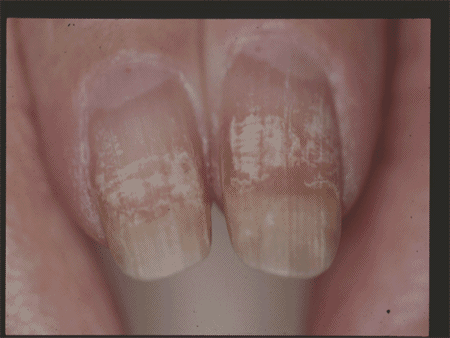
Your favorite clients walks into the salon. You are chatting while you remove her nail polish and she is telling you how she was gardening all weekend and now has a bunch of zucchini and she asks if you would like her to bring you some. You say "That would be great!" and look down at her nails......one of which is as green as the zucchini she was talking about! What in the world happened and how do you fix it?
What are "Greenies"?
Pseudomonas aeruginosa is a common bacteria that can cause disease in plants and animals, including humans. It is found in soil, water, plant, pets, skin flora, and most man-made environments throughout the world. When it grows, it's waste produces pigments that impart the green color of chloronychia (the technical term for green nails caused by p. aeruginosa bacterium).
Normally, nail plate and nail bed are not hospitable places for the bacteria, but if they have become compromised in some way, then the pseudomonas can find a home. It feeds off the dead tissue in the plate of the nail and this is what causes the separation of the nail and nail bed. Chloronychia can occur between the natural nail plate and the nail bed or between an artificial nail coating and the natural nail plate. Some people mistakenly categorize chloronychia as a mold, but in reality mold is not a human pathogen.
How Do You Get It?
This bacterium flourishes in wet environments, such as Jacuzzis (where it can cause a rash), swimming pools (where it can cause swimmer's ear), contact lens solution, sinks, and bath sponges. Because it thrives on moist surfaces, this bacterium is also found on and in medical equipment, including catheters, causing cross-infections in hospitals and clinics.
In a salon environment, the vast majority of infections that occur on nails with no signs of lifting are often caused by the nail tech, according to Doug Schoon. For example, if a client touches her nails to her face and the nail plates aren’t re-cleaned the chances of an infection go up tremendously. That’s why it’s important for both nail techs and clients to wash their hands before every service. Nail techs should also individually clean the nail plates just before applying product. If you get rid of surface moisture and oils (and the bacteria) before product is applied, it will be highly unlikely for your client to get infections. "They're all over us," explains Schoon. "We typically carry hundreds of species of bacteria on our skin at any time, depending on what we're in contact with." Improper application can lead to lifting, which can allow bacteria to get under the area where the product has separated.
"On rare occasions pseudomonas aeruginosa can cause serious infections, particularly of the eyes, so good sanitation and disinfection practices are important for more than just cosmetic reasons," says Vicki Peters. "An untreated greenie can turn into a black/brown nail and can cause the client permanent [nail] damage."
Treating Chloronychia under the Natural Nail
if the infection is under the natural nail it is usually a secondary infection and the client must be referred to a medical doctor who can treat the bacteria and clean up the nail
Treating Chloronychia under Nail Enhancements
It is best to keep nails short and free from enhancements if a Pseudomonas aeruginosa infection is suspected. Instruct your clients to come to you if they experience lifting and not to attempt to take care of the problem themselves by gluing down the lifted area which will trap any bacteria present.
It is possible to work on a client with pseudomonas. According to Dr. Phoebe Rich, the infection is not easily transmitted from person to person in a salon. However, as a precaution, once you use a file on an infected nail, don’t use it on another nail. Wrap it in plastic wrap and toss it in the trash.
To help rid the nail plate of the infection, remove the enhancement, lightly buff the stain to open up the nail plate cells, and remove all moisture and some of the surface oils. Instruct the client to keep the plate clean and dry at all times, and wear gloves when having her hands in water or using household cleaning solutions.
"Pseudomonas will often spontaneously disappear when the underlying nail problem is cleared up. There are several home remedies that will treat pseudomonas very effectively. The simplest treatment is to use diluted white vinegar soaks (1 part vinegar to 2-4 parts water) for several weeks. You can store the solution in a dropper bottle and apply one drop under the nail twice a day. To remove the discoloration, the nails can be rinsed in a diluted bleach solution (1 part bleach to 4 parts water) once or twice, but not for prolonged periods. If these simple remedies fail, a doctor can prescribe antibiotics for resistant cases." — Dr. Phoebe Rich
Ultimately, the nail but be cleaned, disinfected, and have any enhancements removed. But remember, you are a nail tech, not a doctor. If it looks like there is an infection present, do not risk trying to rectify the clients' problem. In most cases, it is actually illegal for a tech to work on nails that appear to be infected. Instead, at this point, you must refer your guest to a medical doctor who can treat the bacteria and clean up the nail
What if We just "leave it alone"
All pseudomonas infections can make you very sick if they spread through the bloodstream. A serious infection can cause symptoms of high fever, chills, confusion, and shock. If the infection spreads to critical body organs, such as the lungs, the urinary tract, and kidneys, the results can be fatal. The infections are hard to treat because the bacteria can resist many types of antibiotics
References
https://en.wikipedia.org/wiki/Pseudomonas_aeruginosa
http://www.nailsmag.com/article/40049/pseudomonas
http://www.aocd.org/?page=GreenNailSyndrome
http://www.nailpro.com/germs-keep-out
http://www.beautyweb.com/Ask_the_Experts/Nails/nail_fungus.htm