Tuesday, September 28, 2021

Where have I been?

I realize that I haven't been active on this blog in quite some time - I am actually working on a Master's degree in an unrelated field and time has slipped away from me. I still have a desire to be active in the nail education sphere, however, and have been relatively active on Quora answering (mostly) nail related questions. 

I do hope to get back to this blog in the near future, but in the meantime feel free to visit me on Quora in my "Busting Nailcare Myths" space or just answering random questions!


You can also follow me at Real World Nails on YouTube, where I have been digitizing a lot of my old nail training videos ("mine" as in I owned the DVDs, not that I made the videos :) )

Friday, August 30, 2019

Russian Manicures Part 2 - the Consequences and Experts Weigh In

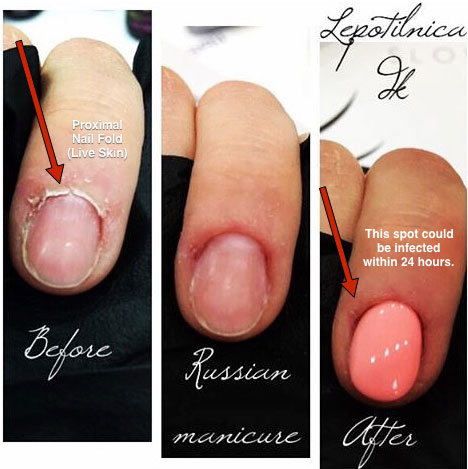
I mean, seriously, that skin looks raw!
In my first post on Russian Manicures, I discussed a couple different Russian Manicure training videos and broke them down step by step.

In this part 2 of my Russian Manicure post, I will present to you what the experts are saying regarding this technique.

Once again, lets remember throughout this that the Eponychium (actually, we now know this should be called the proximal nail fold (PNF)) is living tissue and should never be cut. From the book "Nanotechnology in Dermatology":
"The skin bordering the proximal nail plate is called the eponychium. It does not end at the nail plate, but instead folds back underneath to create a tight seal which prevents pathogens or contaminants form gaining access to the matrix area... [It] serves to help protect and cushion the matrix. This tissue is often mistakenly confused with the cuticle... The cuticle is a vital part of the seal that protects the matrix from pathogenic invasion, which explains why this area should be treated with care when manicuring."
So, what happens when the "Russian manicure" technique is done on a client? Just like with calluses on feet, the more you cut the PNF , the harder than thicker it will grow back trying to protect itself.

Vitaly Solomonoff, founder and president of the Academy of Nail Art and former editor of Nail Spa magazine in Russia, and his colleagues have studied more than 300 cases of people who have had Russian Manicures. They found that 91% of clients who constantly get the Russian manicure have symptoms of the damaged nail matrix or nail bed. "Only 9% of the cases have been determined as safe and “successful” in a long-term period of study (38 months). All 9% of clients have got the manicure from NTs with basic medical education. So, we come to conclusion that deep understanding of the processes in lively skin helps to train the correct technique of this manicure.... Symptoms may not appear right after manicure is performed, the first symptoms occur months after due the constant repetitive traumatization of the cuticle/matrix area. Symptoms include all signs of matrix/nail dystrophy from splitting, horizontal ridges, slow nail grow to the painful neuropathy and high sensitivity. We have also discovered that infectious inflammations are a common issue in those clients who has compromised immune system – diabetics etc....Imperceptible vibration always takes place even with high end e-files and impacts the highly sensitive matrix area and leads to dramatic postponed issues. The technique that may look safe and easy can bring troubles in the future...We strongly believe that micro cracks of the skin are inseminated with bacteria during few hours after the procedure. "

In addition, Solomonoff has said that "The background of the so called 'Russian manicure' is an attempt of e-files distributors to sell their units in Russia. That is why it has been widely advertised as a safe and 'healthy' alternative to clipping the nail cuticles. We, at my company have always stood against this practice unless NT has at least basic medical education and full understanding of Anatomy and Physiology of the nail unit."


Doug Schoon says "Hopefully, this problem may be self-correcting. When those who use these methods start seeing the reported problems associated with these types of manicures, hopefully they'll wake up and smell the coffee. Excessive damage to the skin around the nail plate, excessive regrowth of hardened callus-like tissue, redness, pain, puffiness, weeping/ water-blisters, itching... these are symptoms I'd expect many will see. Not only can this method cause the expected hardening and rapid/excessive regrowth of tissue, the damaged skin is more likely to develop infections. And, product-related skin irritations or allergies are more likely as well. Invaders beware- watch closely for these issues- and don't blame the products- blame your techniques. I'm already hearing of and seeing these problems."

Whatever, My Clients have had No Problems and LOVE the results

The reason your skin feels "softened" after a Russian Manicure is because the electric file wears away layers of  the epidermis - the very layers that work to keep your skin hydrated - and reveal the new, vulnerable skin underneath - often this can even be the dermis layer of the skin, which is not mean to be exposed to the elements.

Remember, you don't have to bleed in order to suffer damage and damage cannot always be seen by the naked eye. An electric file spins at thousands of revolutions a minute. You can be as light handed as you like but you will still cause damage to the natural nail.

Plus it goes against every principle of good nail health and proper technique.

But, other people are doing it!

And if they were all jumping off a cliff, would you do that too?  

Seriously though, here's the thing - if you are in the United States (and many other countries with regulations on the nail industry), the Russian manicure is a technique that is NOT approved by regulatory agencies nor is it covered under insurance company polices (which means a serious financial risk if you perform the service!). Unregulated countries may be 'allowed' to perform this technique ONLY because there are no licensing requirements or regulations. But even if you can so it doesn't mean you should do it.

Educating your clients about the dangers of the technique and encouraging them to share the knowledge with their friends will help reduce the popularity. Yes, there will still be people who "don't care" and will still seek out the service, but for every person we can educate about the dangers, that is one less person seeking out the service and one less person with damaged nails and skin. We do what we can.

What should we be doing instead?

Regular (preferably weekly) manicures using hydroxy acid based exfoliation products and hydrating masks coupled with a good quality cuticle oil twice a day will take a few weeks but you will see a massive improvement without any mechanical intervention.


References:

https://schoonscientific.com/wp-content/uploads/2017/07/May-17-Doug-Schoon-column.pdf
http://www.newnailcreations.com/links
http://www.salongeek.com/threads/russian-manicure-technique.297841/
https://www.nailcarehq.com/russian-manicure-dangerous/
https://www.nailcarehq.com/the-dangers-of-the-russian-manicure/
https://www.facebook.com/athena.elliott1/posts/10210980427719423


It's Been Awhile...

I honestly don't know how many people read this blog regularly, so maybe I haven't been missed, but I wanted to put this out there just in case anyone was wondering.

I started this blog because I have had a lifelong love of nails - so much so that it became a career for me. And I spend a lot of time cringing at the things I see passing for nail "education" on the internet. Since I also love to share knowledge, I thought I would put everything I've learned about nails over the past 20 years up for others to read and maybe help further the nail industry in a better way than what is happening out there now. Plus, it helps me keep my hand in an industry I have always loved.

Of course, life happens and I decided to go back to school and get my masters degree in my current career. Which leaves a lot less time for my beloved nail blog. I still have a lot of unfinished posts that I want to share and I hope to start making time to do so now, even though I am still working full time and am still in school. I truly do want to make even a little bit of difference in the nail industry and this blog is my way of giving back and educating people.

Also, I do still occasionally answer questions on Quora - so feel free to follow me over there for more nail content!


Sunday, May 14, 2017

Russian Manicure Part 1 - Video reviews


If a nail trend has ever given me the willies, its the Russian Manicure (a.k.a combined manicure, Korean manicure, machine manicure). The effect is clean and stunning....and almost always not something that is within scope of a nail tech's license. Having said that, I will say that there are certain parts of the technique that are useful and can be done by a well trained nail tech without damage to the client. But there are other parts of the procedure that literally amount to minor surgery. Lets break this down.


First, a side note. Lets remember throughout this that the eponychium is living tissue and should never be cut. From the book "Nanotechnology in Dermatology":
"The skin bordering the proximal nail plate is called the eponychium. It does not end at the nail plate, but instead folds back underneath to create a tight seal which prevents pathogens or contaminants form gaining access to the matrix area... [It] serves to help protect and cushion the matrix. This tissue is often mistakenly confused with the cuticle... The cuticle is a vital part of the seal that protects the matrix from pathogenic invasion, which explains why this area should be treated with care when manicuring."
Back to our regularly scheduled post:


In the first video, they are using a variety of bits to "clean" the cuticle and eponychium.
  • First, a fine small diamond cylinder bit is used to remove visible cuticle stuck the nail plate. This could be okay, as long as the bit is very fine and care is taken to not over file. There is quite a bit of "dust" on the nail when they do this which is nail plate dust. I don't think that bit is very fine.
  • Second, a needle bit with a blunt edge is used and they instruct you to go "as deep as possible" into the nail grooves. My problem here is that they start pushing under the eponychium to "clean" the cuticle - and in the process are breaking the seal that the eponychium gives to the nail matrix.
  • The third bit is a corundum (stone) bit - which is porous and not disinfectable. You would need to use a new bit for every client. They are using it to smooth the nail plate. This is the third time they have gone over the same area around the sidewalls and eponychium of the nail with a rapidly spinning bit. I don't care how soft the bit is, at this point you are starting to take layers of the nail off.
  • Fourth they use a tiny diamond football (or bullet) to go over again to go even more deeply into the nail folds.
  • A round diamond bit is used to clean raised skin (they keep calling it cuticle but its really living tissue). They also use it to file down the hard, dry skin at the corner of the nails. That makes sense to me, its the same as filing calluses on the feet .

Even worse is the video where they do the same manicure but add scissors. They say that there are 2 instances that you need to use scissors - the first is when your client has "damp cuticle" and is too elastic to get with the machine and the second is for new techs who are not comfortable using the round bit.
  • In this video they show a client with healthy eponychium that is a bit overgrown. They first dry out the moist eponychium with baby powder and then push back the stuck eponychium, (again they keep calling it cuticle, which is wrong)
  • They then use the diamond bit to remove cuticle on the nail plate (which they keep calling pterygium, which is also wrong) and to push up under the eponychum that they pushed back in the first step. Their goal is to raise that eponychium off the nail plate in order to be able to grab it with scissors later. They use the same bit along the sidewalls
  • They powder the skin again to dry it and then use a scissors to cut off the raised eponychium., This is the part where I can't help but cringe.
  • Next they are using a corundum (stone) bit to remove the cuticle that is leftover on the nail plate and smooth the nail plate. Again these bits are porous and not disinfectable.
  • They next use the round diamond bit along the edge where they just cut off the eponychium to further raise the skin "for later cleaning" and then file any raised skin off using the same bit as well as filing down any hard skin on the sides of the nail.
  • They use another corundum (stone) bit to smooth the skin around the nail. 
  • Then they push back the eponychium with a pusher again. How much trauma can this finger withstand??
What are your thoughts on these procedures??

Part 2 of Russian Manicures -  the Consequences and Experts Weigh In coming soon!

Saturday, May 13, 2017

My answer to Quora post: What are the drawbacks of wearing acrylic nails?

I frequent Quora.com as a means to try to do my part in busting myths about nails. (Sigh, it really does feel like an uphill battle sometimes.) I thought that it would be good to share my response to this question here as well 🙂

All images are not mine and were taken from Google images.


First, a disclaimer: as a licensed nail tech, I truly believe that any type of artificial nail can be worn without damage or infection if done correctly. I’ve worn nails for over 20 years and neither I nor any of my clients EVER had the issues I am going to describe below. TLDR at the very bottom
OK. The first drawback is the lack of education in the nail industry. You are more likely to find a poorly trained (or even untrained and unlicensed) nail tech than you are going to find one that is well-trained and knowledgeable about the science of nails. Even nail techs who are licensed are only trained in the basics, so you need to look for one who is not only licensed (in the US, other countries may not have licensure) BUT also has a lot of continuing education under their belt Just having a license is not enough.

Untrained/under-trained nail techs often do not understand the chemistry of nails. They don’t understand (or care) that mixing product brands and being sloppy with application (liquid all over the skin) can lead to overexposure and can cause allergic reactions or dermatitis in their clients. Once a client becomes allergic to products, they can never again wear artificial nails because almost all of the various products we use are chemically related. (Some are chemically different, but who wants to go through this every time they try a new product just to see if it doesn't happen again?)

Damaged natural nails. Nail damage is not inevitable when wearing artificial nails. Acrylic itself does not damage the natural nail. Improper application and removal damages natural nails. And untrained/under-trained nail techs are almost always just following procedures that were taught to them by other untrained/under-trained nail techs. When applying acrylic nails, the tech only needs to use a very fine file to gently break up the blocks of oil n the nail There is zero need to shred or etch the natural nail with today’s advanced acrylic products. But an untrained tech doesn't know that so they use a coarse file or an electric file with a coarse sanding band to remove layers of the natural nail (makes me cringe to think about).

Then when they file the top of the acrylic nail or do a fill, they are improperly using an electric file again at the wrong angle and they cut into the the natural nail causing “rings of fire”which you can see through the acrylic in this pic:

And then when nails are removed, they are either picked or pried off, which brings layers of the natural nail with it:

Bad removal vs good removal: (not my image, got it off the internet :))


MMA. This is a post unto itself, so I will try to be brief. MMA is an illegal (the FDA says it is hazardous and deleterious when used on nails) acrylic nail liquid that is still used in cheap nail salons because it is so cheap. It doesn't stick well and REQUIRES rough etching of the natural nail (thinning and damaging it) to get the product to adhere. But once adhered, it is overly hard and attaches too rigidly to the natural nail - meaning if you break a nail, instead of the acrylic breaking, it tears your natural nail off the nail bed. It is also extremely hard to remove and so most salons who use it will pry the acrylic off the natural nail, further damaging it MMA is the reason the myth that acrylic nails damage the natural nails still exists. (Gross pics follow)


Unsanitary salons: Fungus is not something that is destined to happen with acrylic nails, but it can happen if the salon you frequent is unsanitary. So can other infections such as mycobacteria , pseudomonas, and even Hepatitis.


So yes, there are risks with wearing artificial nails if you go to a nail tech who is poorly trained (and sadly, its something like 80% of nail techs that fall into this category)

Monday, May 1, 2017

Once and For All, UV Lamps are SAFE

In November, 2008, a study was published that claimed that UV Nail Lamps caused cancer. In this study two healthy women with no family history of skin cancer developed melanoma after repeated use of nail salon UV lamps. Of course, the internet grabbed on to this story and ran with it. The problem is, the study was faulty. First of all, the sample size was 2 people. Two. Both who live in Texas - which, if you don’t know, is a very sunny southern state in the US. The study also made faulty conclusions based on the UV output of tanning beds, which are significantly stronger than the UV output of nail lamps and they assumed the UV-A energy exposure from nail lamps would fall within the estimated range determined to be potentially carcinogenic.
Since then, at least three additional studies have been completed, all coming to the conclusion that UV Nail lamps are indeed safe.
The Lighting Sciences study in 2010 concluded that “UV-B output is less than what occurs in natural sunlight and is equal to what a person could expect from spending an extra 17 to 26 seconds in sunlight each day during the two weeks between nail salon appointments” and “UV-A exposure is equivalent to spending an extra 1.5 to 2.7 minutes in sunlight each day between salon visits, depending on the type of UV nail lamp used.”
In December, 2012, The Massachusetts General Hospital /Alpert Medical School at Brown University study concluded that "Nail lamps are safe for over 250 years of weekly manicures, and even then there would be a low risk of skin cancer”. They also concluded that “Although some sources of UVA and UVB contribute to the development of KCs [keratinocyte carcinoma], UV nail lamps do not appear to significantly increase the lifetime risk of KC. Dermatologists and primary-care physicians may reassure patients regarding the safety of these devices.
Testing by Sayre and Dowdy in July 2013 found that found that UV nail lights were even safer than expected. “All of the various UV nail lamps submitted for evaluation were found to be significantly less hazardous than might have been anticipated based on the initial concerns raised…” They also confirmed that UV nail lamps are NOT equivalent to tanning beds or indoor tanning lamps, largely because nail lamps use vastly different types of UV bulbs which produce different ranges of wavelengths with significantly lower intensities.
In addition, “The study demonstrates that UV exposure is so low that a worker could put their hand under a UV nail lamp from this study for 25 minutes each day without exceeding established internationally accepted safe limits or ‘permissible daily exposures’.”
In numerous interviews and research, Dr. Sayre has stated that the use of UV nail lamps does not contribute to the risk of getting skin cancer and that the emissions from UV nail lamps are safer than that of natural sunlight.
In 2013, The Skin Cancer Foundation put out an official statement that “even the most intense of these devices presents only a moderate UV risk – a far lower risk than that presented by UV tanning devices”. Of course, to play it safe, they still recommend sunscreen, as they do with any UV exposure.

So, in conclusion, UV lamps are completely safe. There is no evidence that these lamps cause cancer and there has never been a cancer case proven to have come from these lamps in the 30+ years they have been in use. You may wish to mitigate risk by wearing sunscreen if desired.

Sunday, April 30, 2017

Dip Systems - take 2

If you read my previous post, you would see that a major con of “Tip & dip” systems is that they just do not last as long as acrylics or hard gels. I don’t mean they don’t last as long between appointments – that, of course, depends on nail prep and the growth rate of the client’s nails – rather, they tend to break down after a few fills as nail resin is not cross-linked and therefore is very porous and susceptible to moisture and the environment. They crack and yellow and need to be removed periodically and reapplied.
Young Nails SlickPour System


Since my last post on the subject, the trend seems to have shifted in the use of these systems to be not so much an alternative for acrylic or hard gel nails, rather they are now being touted as an alternative for Gel Polish, something I am finding very interesting indeed.

Basically, techs are now soaking off and re-applying a whole new set at every appointment. They are not using tips and they are using colored powders instead of the traditional clear or pink and white powders.  Personally I think dip systems are much better suited to this type of application then the “tip and dip” acrylic alternative method that has been pushed since the 1980’s. 

Only time will tell if this usage of the dip system will finally make it a staple in the nail industry or if it will once again fade away only to be resurrected a few years later as the “latest and greatest new thing”.

Tell me - how do you use dip systems? 

Monday, April 24, 2017

Business Basics: Professionalism

The contrast between my life in the beauty industry and my life in the business sector is astounding. I used to work in a Human Resources support role for a Fortune 500 company in their Organizational Development department. In that role, I was exposed to training and expectations for their high level executives. The expectations for business professionals is vastly different from how the majority of beauty professionals act nowadays - and its not that beauty professionals have a less important job by any means, its that business and the importance of professionalism isn't even touched  in the beauty industry unless you take a rare advanced training beauty business class.

Look, I get it. This is a creative industry. You did not go to school for business because its too stodgy/ boring/{insert adjective here}. Except you DID go into business - the beauty business.   

Professionalism

Professionalism is a set of character strengths and values directed toward high quality service to others through one's work. It encompasses the skills, knowledge and behavior that you use at work and that you present to the outside world as a beauty professional, even if not at work . Let me repeat that - even if not at work.   If you are representing the company in any capacity - even just talking about where you work to an acquaintance -  your behavior will be judged in relation to your job.

Professionalism isn't how you look, it's how you behave.  It's saying what you mean, doing what you say, and getting the job done.  People who act professionally are regarded better by both peers and clients, make more money and are seen as experts in their chosen field.   People who act professionally are valued by their company. Professionalism establishes boundaries to clients. It promotes respect and minimizes conflicts.

Of course, how you look still matters. Being neat and clean is important in order to look professional. What would you think if you went to a doctor who was wearing a sloppy, stained sweatsuit and had matted, messy hair? Your opinion of their professionalism - and probably their competency - would go down and you might even be uncomfortable seeing them.

Characteristic of Professionals - in ANY Industry


  • Neat in appearance - while professionalism is a set of behaviors, appearance still matters, ESPECIALLY in the beauty industry.
  • Polite and well-spoken but not cocky
  • Reliable
  • Competent in their role and always striving to become experts in their field
  • Ethical
  • Organized
  • Accountable for their actions - they admit their admit mistakes and correct them and don't try to blame others
  • Maintain poise - they keep their calm in difficult situations
  • Respectful of others - customers, superiors and co-workers alike


Professionalism is important, even if you do not work for a Fortune 500 company. By maintaining professionalism, you will go further in your career, make more money and be regarded as an expert in your field.  Its a win-win situation!

Unprofessional Behavior

Unprofessional behavior happens, but a true professional will strive to not let it happen and to minimize issues when it dies happen (to them or someone else in their place of employment.

Unprofessional behavior can include:
I love this picture! from LinkedIn

  • Being late or skipping work.
  • Discussing taboo topics or your personal life
  • Swearing
  • Being defensive
  • Being unresponsive
  • Being disrespectful
  • Not keeping promises
  • Blaming other people
  • Being fake
  • Lying and stealing
  • Poor communication
  • Arguing in front of clients
  • Insults, verbal comments, or criticism intended to belittle or berate others
  • Verbal outbursts
  • Conduct that can be considered harassment or discrimination
  • Verbal or physical threats of violence, retribution, or lawsuits
  • Any of these examples


I highly encourage you to keep reading and researching on the subject of Professionalism and even take a class if you can. It is an extremely important piece of making a viable career that is not talked about often enough in this industry.


Resources and References
https://www.strategies.com/blog/career-professionalism-success-beauty-industry/
http://beautysupply.about.com/od/Marketing/tp/Keeping-It-Professional-In-The-Beauty-Industry.htm
http://www.modernsalon.com/article/7511/9-essential-work-ethics-for-salon-success
http://brainwashedu.com/raising-the-professionalism-of-the-beauty-industry/
https://www.linkedin.com/pulse/10-characteristics-professionalism-greg
https://www.usatoday.com/story/money/business/2014/08/02/unprofessional-workplace-behaviors/13420381/
https://www.linkedin.com/pulse/20140706111652-12357314-top-10-most-common-unprofessional-behaviors
https://www.slideshare.net/tammyjwatson1969/professionalism-in-the-workplace-37460714
https://www.slideshare.net/wicaksana/professionalism-in-the-work-place
http://www.rasmussen.edu/student-life/blogs/main/four-reasons-why-you-need-to-be-professional/
http://smallbusiness.chron.com/importance-professionalism-business-2905.html


Sunday, April 23, 2017

Business Basics: Communicating with Clients

This is your new mantra: Clients are not your friends.  They pay you to do a service.  You are a professional.

Acting professionally isn't just about how you carry yourself while at work, nowadays with social media, it is also about how you carry yourself in your online presence.

Social Media

Clients are not your friends.  They pay you to do a service.  You are a professional.


Social media: noun; websites and applications that enable users to create and share content or participate in social networking. See: Instagram, Facebook, YouTube, Tumbler, Snap Chat, Periscope, Twitter, Pinterest, Reddit, LinkedIn, blogs, et cetera, et cetera.

Social media has made it so easy for an average Nail Tech (or any one else) to market themselves quickly, cheaply and effectively.  For a small business, or even an average technician looking for clients, social media is an amazing invention that allows free, instant self promotion. However, it is that "instant" piece that gets people into trouble. Always think before you post! I have seen nail techs post the most unprofessional things on their business pages. From one person who literally posted that they were looking for a surrogate to have a baby, to another who posted a meme that was taken as anti-religious and who lost a lot of religious followers due to that single post. And many, many more who post negative things about other businesses, people, their baby daddy...it goes on and on. Your personal life and professional life should NEVER be intermixed in your social media.

Spelling and Grammar Count!

A professional social media page needs to be proofread. Misspellings and poor grammar bring down your professional image and credibility.  I know typos happen to the best of us - but if you do not know the difference between your and you're or too, two and to, look it up before you post something. It may sound trivial, but it absolutely brings down the image of you as a tech, the image of the industry as a whole and perpetuates the "nail techs are just dumb people who can't hack a real job" myth.  Poor grammar and spelling comes across as unprofessional and gives the impression that you don't take your role seriously.  In the business world, you will never see an advertisement with misspellings or poor grammar because that would present a very poor image of the business.

Similarly, proper punctuation and capitalization show professionalism just as much as proper grammar and spelling.

Social Media is Advertising

As I said above, in the business world, you will never see an advertisement with misspellings or poor grammar because that would present a very poor image of the business.  Social media is your advertising platform, treat it as such. There is an entire profession of people who do nothing but craft advertisements and marketing campaigns. If you are going to compete with corporate salons who use professional marketers and advertisers, you need to act professionally on your business social media pages. Period.

Text Messages

Clients are not your friends.  They pay you to do a service.  You are a professional.
No one is saying you can't text your clients - in this day and age more and more clients prefer to text over calling for an appointment. The main thing is that you set boundaries with your clients.

If your lawyer or doctor or dentist texted you at 11 pm "smh. I SAID I would get you in on sat. you hv to lmk when"  What would you think?  Not very professional, right? Personally I would find a new lawyer/doctor/dentist if that happened.

Ideally you would have a separate phone number for work, but if for some reason you cannot do this, you will need to learn to manage your work texts.
  1. There are many services that you can set up to take online and make text appointment reminders.  Yes they have a service fee but it may be worth it to you to save your sanity. Acuity Scheduling is one and is only $10 a month  and Appointment Tell is a service that reminds clients via text, email or phone message and may also be helpful if you don't need a full scheduling software ( I am not affiliated with them, nor have used them, just pointing out these services exist).
  2. Use Google Voice - you can get a second phone number that forwards to your cell/home/work phone and you can dictate hours in which to receive calls and texts.  Use that phone number for clients.
  3. Make it very clear on your business cards/websites/social media that clients can text your phone during business hours only (of course there will always be clients who don't read or care about what you put out there...)

In Your Chair

Clients are not your friends.  They pay you to do a service.  You are a professional.
Having said that, yes you will sometimes have actual friends in your chair.  And some regular clients become very close with you after years of seeing you.  But in your chair, they are clients.  They are paying you to do a service.  You need to wear your "professional" hat and put the "friend" hat away for later. Yes, you can be friendly but keep in mind that topics of conversation in any workplace should not start a debate or invoke strong emotions.  Politics, religion, your health, your finances, risque jokes, sex and sexuality, problems in your relationships, gossiping about coworkers...all of these are majorly "off limits".  I realize it is hard when the person sitting across from you has know you since grade school, but remember this is your career, not your living room, and if you work in a salon or spa with other people anyone could overhear you.  Keep it neutral.

By keeping your place of work professional, clients will respect you.  Once you start becoming too informal, they start to think you are friends and should give them discounts.


Say it with me now: Clients are not your friends.  They pay you to do a service.  You are a professional.

You can do this!


References and Resources:
http://www.nailsmag.com/article/96401/texting-over-a-landline
http://www.fiercehealthit.com/story/maintaining-professionalism-social-media-heres-how/2013-04-12
http://www.thegrindstone.com/2011/06/27/career-management/office-etiquette-inappropriate-workplace-topics-you-should-avoid/
https://gigaom.com/2010/10/08/professionalism-and-social-media/
http://www.mw-creative.co.uk/social-media-tips-beauty-industry-2014/
http://salonnerds.com/social-media-marketing-importance-hair-salons/
http://thehairartistassociation.org/2013/05/5-common-social-media-mistakes-beauty-salons-make-and-how-to-avoid-them/

Saturday, April 22, 2017

The Myth of Solar Nails

In the 1970's the Nail Industry was an unregulated industry and most nail technicians used MMA from dental supply houses to form acrylic nails. One day in the late 1970's, a patient of Dr. Stuart Nordstrom, a dentist from California, remarked that the product that he was using to prepare temporary caps for her teeth smelled like the product that was used on her nails (called "porcelain nails" instead of "acrylic nails" back then). This sparked Dr. Nordstrom to develop SolarNail, the first acrylic nail product formulated to be thin, non-yellowing and strong. Which lead to his company - CND (Creative Nail Design) being formed in 1979.

Over the years CND has innovated and produced better and stronger products and the original SolarNail Liquid was discontinued. However, Radical SolarNail - a much improved version of the original SolarNail liquid - still exists. "SolarNail" remains a trademark of CND.  In the early 1980's SolarNail became synonymous with Pink and White French acrylic nails due to a marketing campaign done by Creative Nail Design. The marketing said that SolarNails were better than regular Acrylic/Porcelain nails because they were formulated specifically for nails (or something like that).
Notice Solar Nails on the menu :(

Fast forward to today. There are salons that still advertise "Solar Nails" as being "better" than acrylic nails. This is referring to the very old marketing campaign I mentioned above which said that said that SolarNail was superior to the MMA acrylic commonly used at the time. It was superior at the time. The thing is, they didn't really highlight that SolarNail was a brand of acrylic. They were trying to differentiate themselves from the thick, yellow, horrible acrylic or "porcelain" nails of the time. And it worked.  CND has a habit of marketing themselves as something different - take Shellac, which is a brand of gel polish made by CND. It is gel polish, but their marketing campaign is such that it calls itself a hybrid and claims to be something completely different than other gel polish. Chemically, there is a bit of difference between Shellac and most soak off gels, but that doesn't change the fact that as a product category, its just gel polish.

Unfortunately, CND's marketing works so well that to this day, there are people who believe that SolarNail is a completely different product from acrylic nails.


OK, so what have we learned?

  • SolarNail is acrylic nails (remember, Liquid + powder = acrylic)
  • SolarNail is an old, discontinued brand name of acrylic from CND
  • Solar Nails almost always mean Pink & White nails, though almost never mean they are using SolarNail products (being discontinued and all).
  • Clients are very trusting and believe salons that tell them Solar Nails are a thing.
  • Salons that use the term "Solar Nails" are stuck in the 1980's and/or are knowingly misleading clients. Is this the type of salon you want to patronize?


References 
http://www.nailsmag.com/encyclopedia/64286/cnd-creative-nail-design
https://cnd.com/about/heritage

The Problem With Social Media "teachers"

Eep! I just realized it's been over a year since I have posted anything!  Ah, life tends to catch up with you doesn't it? Well I have tons of post drafts just waiting to be edited and I hope to start geting them out there for you soon!

Just a few years ago, we had to rely on books and in-person teaching and an occasional online forum (hi, beautytech.com!) to learn and collaborate with people.  Social media is amazing and the ability to share ideas, learn, network and more is there at the click of a mouse button.  Instagram is a fantastic place to see other tech's work. YouTube has a proliferation of videos on "how to do nails".  Facebook has groups galore with nails as the subject. It can be the best place to learn new things. Or the worst.

I follow a number of people on Instagram and YouTube - online nail "celebrities" - and am appalled at the number of problems I see being shown in the short videos they post. And so many of them are offering classes - even though they have never trained to teach and are using outdated and potentially harmful techniques.

I am not saying don't use social media, just to take what you see with a grain of salt. Over filing the natural nail, too much liquid and mixing product lines are all things I see online way too often. As an informed tech, it is up to you to do your research, know what is acceptable and what is not  - and when you see a tech online doing amazing nails - except they are slopping monomer all over the finger and mixing acrylic brands - you can take the good ideas that you see and leave the bad techniques.

Do what you can to keep this industry safe and healthy! There is no point pointing out to the tech that they have a bad habit or were poorly trained - you will get called a troll and there will always be people to stand up for them no matter how much you make sense  (been there!)

Keep Learning!!

Tuesday, February 23, 2016

Nail Polish: History, Chemistry and Controversy

My name is Jessica and I am a nail polish addict.  I have at least 250 personal bottles of polish, not counting my gel polish or stamping polish and this is AFTER I cleaned out my stash several years ago.  I know I am not the only one, and I believe many nail techs start their career with a polish addiction!  (but that's just my informal observation)

Nail Polish seems to have been pushed to the background in the last few years. Gel polish has become the buzz word in manicures - to the extent that consumers no longer realize that "gel nails" and "gel polish" are different things.  But I digress.  Nail polish just isn't getting the press that it used to and there are people who think that nail polish (lacquer, varnish, etc. - all names for the same thing) is on its way out.  Nothing could be further from the truth. 

For one thing, as nail techs know, not every person gets their nails done in a salon and no matter how "easy" the at-home gel polish kits say they are, there is a vast majority of consumers who do not want to put in the time and effort to learn to apply gel polish at home.  There are consumers who have strong natural nails and get the same wear form nail polish vs. gel polish. There are consumers who like to change their polish frequently and do not want to be "stuck" with one color.  there are consumers who have had bad experiences with gel polish and refuse to acknowledge that the fault is not with the product but with the technician. And there are consumers who just love nail polish.

History

According to historians and archeologists, nail polish was invented 5000 years ago in China from a mixture that included beeswax, egg whites, gelatin, vegetable dyes, and gum Arabic.  It was used by ruling class to distinguish themselves from the general population. Favorite colors were silver and gold because they symbolized power and wealth. Eventually, metallic gave way to red and black colors as royal favorites. At one point, nail polish was not allowed to be used by general population an evidence has been found that common people were publicly executed if found with colored nails.

From China, nail polish spread across India, Middle East and northern Africa, where it was extensively used in Egypt.  There, the lower classes wore pale colors, whereas high society used henna to color their nails a reddish brown. It was also known that mummified pharaohs would have their nails colored with henna.

After the fall of Roman Empire, nail polish disappeared from the European fashion . It was only after
the arrival of renaissance and the new trade connection with the Middle East and India that European aristocracy gain access to the nail polish. As time went on, nail polish and manicures became more and more common. In Victorian era culture it was generally considered improper for women to adorn themselves with either makeup or nail coloring, with natural appearances being considered more chaste and pure, so fashionable women of the day would manicure their nails by applying tinted powders and creams to the nail plate, then buffing them until shiny.


Interestingly, it was the invention of the car that spurred the creation of the first modern-day nail polish. The very first nail lacquer was a cousin of automobile paint - it was completely colorless and was introduced in 1916 (some say 1917) by Cutex.  Revlon became the first established nail polish brand in 1932 when they released a cream color and began using pigments rather than dyes in their new nail lacquer. In 1976, Jeff Pink (Orly) invented the French Manicure to mimic the look of the white pencil that French models would wear under their nails to give them a clean look.  Nail polish trends continue to evolve with nail art being a huge trend right now.

Here is a fun info graphic from mentalfloss.com on the history of polish

Chemistry

All nail polish is very similar in terms of the broad formulations. 

Nail Polish Ingredients:
  • Solvents- Solvents are liquids used to mix the other ingredients and help them flow smoothly. Once you apply the polish, solvents evaporate away (ethyl acetate, butyl acetate,  isopropyl alcohol, toluene, xylene)
  • Film Formers- chemicals that form the smooth surface on a coat of nail polish (nitrocellulose or cellulose acetate butyrate). 
  • Resins - modifies the nitrocellulose to form a tough and shiny film - the film adhere to the nail plate and adds depth, gloss and hardness to the film of a nail polish (tosylamide-formaldehyde resin or tosylamide/epoxy resin )
  • Plasticizers- keep polish flexible and counteract the brittleness of the resins and film formers (Camphor and  Dibutylphthalate)
  • Pigments - This is what gives nail polish it's color.  Iron oxides, micas, FD&C colorants and other things (such as carmine) may be used for color
  • Other Additives - including UV blockers (benzophenone-1), glitter and thickening agents  that help keep pigments suspended (stearalkonium hectorite or bentonite).
Once nail polish is painted on the nail, the solvent gradually evaporates away entirely and the nitrocellulose, resins, plasticizers and color is left behind, drying into a solid film on your nail.

Because nail polish cures by evaporation, if you use a quick dry top coat that doesn't penetrate through the layers of polish (essentially drying itself but not the polish under it) then you can end up with bubbles from the solvent trying to escape through the dried top coat.  This is the same problem you have with quick dry sprays or putting your hands in ice water - its not drying the polish, jus the very top layer which can cause more issues.  Just wait for your polish to dry naturally (or use a really good quick dry top coat!), okay?

Controversy

Nail polish products have been used safely for many decades by millions of people. Fingernails and toenails are made of keratin, which is hard and largely impenetrable. Once nail polishes, treatments, and hardeners dry, the ingredients in the products become embedded in the hardened film coating on the surface of the nail, and are not able to be absorbed by the body or released into the air. The US Food and Drug Administration states on its website that such as toluene, formaldehyde, and dibutyl phthalate are safe under current conditions of use in nail products, though formaldehyde resins may cause an irritation or allergic reaction to those individuals sensitized to this compound. In Europe, the Scientific Committee on Consumer Safety (SCCS) reviewed formaldehyde use in nail hardeners in 2014 and concluded that formaldehyde can be safely used up to 2.2% to harden or strengthen nails. I have listed a number of articles and myth busters in the references section below because frankly, I could go on for days on the scare-mongering that is out there about nail polish!  Suffice to say that the Environmental Working Group (EWG) is the leading advocacy group that consistently distorts various studies for the purposes of exaggerating the risks so they can intentionally create unwarranted fear. The more people they scare, the more people donate to them.  I highly suggest reading Doug Schoon's article regarding formaldehyde in nail polish and his take on the EWG's "report" on TPHP in nail polish. A couple of interesting points: the Duke Study recognizes that the nail plate is known to have “low permeability to most molecules” and people who don't wear nail polish were found with TPHP in their urine due to environmental factors - yet the EWG leaves these points out completely. 

I want to encourage you to not blindly follow anyone (even me!) without doing the research and finding out things for yourself.

Tell me: do you still love nail polish?


References:
https://www.facebook.com/DougSchoonsBrain/posts/1055711521127935?pnref=story
http://www.schoonscientific.com/downloads/tech-articles/article-Exposing-The-Formaldehyde-Myth.pdf
http://www.alllacqueredup.com/2015/10/tphp-nail-polish-dangerous-scare-tactic.html
http://chemistry.about.com/od/chemicalcomposition/a/Nail-Polish-Chemistry.htm
http://the-toast.net/2014/10/01/gal-science-nail-polish-works/
http://chemistscorner.com/cosmetic-formulation-basics-nail-polish/
https://en.wikipedia.org/wiki/Nail_polish
https://www.nailcarehq.com/doug-schoon/
http://www.goodhousekeeping.com/beauty/nails/tips/a24202/nail-polish-facts/
http://www.cosmeticsinfo.org/product/nail-products

Thursday, February 11, 2016

Enhancement Troubleshooting: Lifting nails

You apply a beautiful let of nail enhancements and when your client comes back in 2 weeks you see lifting!  What went wrong?
from http://www.nailsmag.com

Assessing the Nail

First, lets assess the nail - where is the lifting occurring?  Is it at the cuticle?  Is it at the point where the tip meets the natural nail?  Is it along the sidewalls?  Is there a lot of lifting or just a little bit? Is it on all fingers or just one or two? 
By assessing the issues, we can narrow down the cause.  For instance, if the nail is lifting at the cuticle, the issue is not with the tip application.  If the lifting is at the sidewalls, but the cuticle is not lifted, I would take a look at my preparation of the sidewall area and confirm that my product is not flooding the area.  If every single nail is lifted half way from the cuticle up the nail plate, then I know it is a bigger issue than just accidentally bad prep on one nail. Its possible the extension is too long for the natural nail but it could be a systemic issue with the client or my mix ratio or a number of other things.  If only one client has issues and no one else does, then I know its something to do with her (body chemistry, picking, medications, allergy to the product) and most likely not my fault.

Causes


There are a number of reasons nails delaminate (the scientific for lifting), though there are just a few "main" causes.  The three factors that are the most likely cause of lifting are:
  • Improper Prep
  • Product touching skin
  • Improper mix ratio (for acrylics) or improper curing (for gel nails)

Lets first take a look at these three possible causes:

Improper Prep

Prepping the natural nail is the first and arguably one of the most important steps in applying enhancements.  This is because it creates the foundation for what you do on top of it. Incompletely removing oils or non-living tissues on the entire nail plate will cause lifting. Etching the nail with a  coarse file can cause lifting by thinning out the nail and creating a weak base for the enhancement which then flexes away from the product with any pressure.

Product Touching Skin

If the product touches the skin at any time (even if you quickly wipe it away), it will wick the skin's oils and moisture into the product which can cause or exacerbate lifting.  I see many people on Instagram who tout themselves as educators who get product on the skin then use their brush to "clean up" around the nail.  Not only is this a major cause of lifting, but can cause dermatitis in the client!  It's better to get your application under control than to try and fix the mess afterwards.

Mix Ratio/Improper Curing

I have talked extensively about the reasons for proper mix ratio and the chemistry behind it in this post.  Basically, acrylic mix ratio is important for many reasons, one of which is that it can cause lifting if it is incorrect.  If the mix is too dry, it does not have time to adhere to the nail fully before hardening. When it is too wet, it can cause pocket lifting and is generally weaker than a properly made acrylic bead.  Not to mention, the chance of overexposure for the client!

With gel nails, you do not have to mix anything so mix ratio is not a factor.  however, it is extremely important that the correct UV/LED lamp with clean bulbs and appropriate cure time is being used  to cure the gel. gel feels hard within seconds but is NOT fully cured until the full cure time has been acheived.  Uncured gel can cause overexposure and dermatitis in clients and lead to a weak nail that does not fully adhere to the natural nail plate.

Other Causes

If you have lifting, checking the above three items should be first on your list.  If you find that they are not the issue, there is a wide variety of other factors that could cause or contribute to the problem, including:
  • Clients who pick at their nails or are extremely hard on their nails
  • Extension is too long for the client's natural nail and lifestyle
  • Too much primer was used
  • The product was applied too thick - thicker is not better and a thick enhancement can be too rigid while the natural nail will flex away from it with any kind of pressure.
  • The tip doesn't fit the natural nail
  • Tip adhesive breakdown
  • Contaminated products
    • Fresh monomer wasn't used with every client
    • Mixing different manufacturers' products
  • Smoking, eating, touching hair, etc. during application (playing with phones always leads to someone touching their nail!)
  • Excessive filing of the enhancement - pressing too hard while filing can flex the softer natural nail away from the hard enhancement
  • Mixing products between systems or brands 
Most of these are self explanatory, but lets talk about tips for a second.  Tips can loosen for several reasons, one reason is improper nail plate preparation prior to tip nail application. Another cause is improper fitting of the tip. Always measure the tip based on the width of the side walls, not the width of the natural free edge. The tip should not be able to be rocked side to side, the nail plate is the same width as the free edge, and the sides of the tip are coming out straight from the side groove.

A third (and most common) cause of tips loosening is the adhesive.  We have talked about adhesives in this blog before and the fact is that all nail adhesives are water soluble.  The thicker the adhesive, the slower they break down but they WILL break down eventually!  If you are lucky your client's nails grow fast and the tip will be gone (filed off during fills) before the issue shows itself.  If you arenot lucky you will start to see lifting at the point where the tip was adhered to the natural nail.

If you prefer to use tips over sculpting, make sure to pretailor the tip so that the minimal amount of adhesive is on the nail plate to create the strongest tip possible. Or you can use acrylic to apply tips for an even stronger nail.

Medications - Not a lifting Culprit!

Its been said for years that lifting might be casue by medicfatgions that the client is taking, however Doug Schoon has said that there is no evidence of this being true:  "This is not likely to be a problems and here’s why. Doctors often state that the health of the natural nail is often a window into the health of the individual. However, taking medication for a month or two isn’t going to affect adhesion of artificial nails or coatings to the nail plates. Same is true for birth control or other over-the-counter (OTC) medications. There are certain medications that when taken for long periods can affect the way the body functions and may affect nail growth. However, this is would be uncommon for medications in general. An example of medications that do affect nail plate growth are chemotherapy drugs. They can adversely affect the growth, but won’t change the way pre-existing natural nails adhere to the nail coating. In other words, they can’t affect the chemical structure of the nail plate once it has already grown from the nail matrix ... Also, if a person is taking a lot of medications and their nails are in poor condition, it is more likely that the condition of the nail plate is due to poor health of the body, and not the medications. For instance, those taking heart medication may also have blood pressure and circulation problems and these health issues are far more likely to adversely affect the condition of new nail growth, than would the medications themselves."

References/Resources

Sunday, January 24, 2016

Soft (Soak-off) Gel vs Hard Gel

We have discussed the chemistry of hard gel nails and how gel nails interact with UV/LED lamps. In this post I am going to compare soak off gels (SOG) - aka soft gels or gel polish - with what we know about gel nail enhancements - aka hard gels.
Image courtesy of nsinails.com

In very basic terms, "hard gels" are the original gel nail enhancements - they are clear, hard, non-porous, flexible and must be removed by soaking off.  They are highly non-porous and solvent resistant, which is why they must be filed off, but that also means that it is almost unheard of for them to yellow due to staining or with exposure to chemicals or sun.

Soft gel/ soak off gel/ hybrid gel polish is very flexible, thin, generally require only minimal nail preparation before application, and most times are not build-able (though there are brands now making soak off gel builders and Biosculpture has made build-able soak off colored gels for over 25 years).   

Hard gels and soak off gels have a very similar base - however soak-off gels are a specifically designed and formulated acrylate base with a higher molecular weight which results in an elongated molecular structure. This creates space between the cross-linking agents and the oligomers allowing penetration of solvents which break down the gel.


UV/LED lamps work the same with soak off gels as they do with hard gels.  And as with hard gels, using one lamp for all products is risky because you run the risk of under- or over-curing. You may not even realize the gel is under-cured (it will look hard on top well before it’s actually done fully curing), so you could unknowingly be exposing the client to uncured product, which can cause adverse skin reactions.  I cannot stress this enough.  Please read my posts on lamps (part 2 here)

One very interesting quality about soak off gels is that they actually get harder to remove the longer they are on the natural nail (per Doug Schoon, president of Schoon Scientific and renowned nail industry chemist).  Just like any nail enhancement, they should be maintained every 2-3 weeks. And remember, that not all enhancements work for all people. so if a client can't get more than a few days of of wear out of a soak off gel, they might want to consider as stronger enhancement. I know this from personal experience - I can usually get 1-2 days of wear out or regular nail polish on my natural nails and gel polish gives me 3-4 days, if I'm lucky,

As with any nail enhancement (and they ARE enhancements, even if they are not mean to be worn as long as a hard gel), improper preparation and improper removal can still damage the natural nail, as many clients have unfortunately found out. “Gel-polish should come off easily with no heavy-handed or forceful scraping,” says Doug Schoon. “If you have to force the product off at all, you are doing something wrong.”
Courtesy of Doug Schoon


References/Resources
http://www.nsinails.com/nail-lab/science-of-beauty/differences-between-soak-off-traditional-gels.html
http://www.nailsmag.com/article/107486/why-two-weeks-is-best

Sunday, January 10, 2016

Enhancement Troubleshooting: Free Edge Separation

One of the most common problems a nail tech sees during a fill service is separation of the natural nail from the enhancement at the nail tip.  It can be very frustrating to have zero lifting or issues anywhere else but the tip is peeling away!

Causes
There are a number of reasons for free edge separation:
  • Nail tip adhesive break down
  • Improper mix ratio in acrylic - especially too wet of a ratio which may not lift at the cuticle but often pulls away at the tip.
  • Using old bulbs with gel
  • Clients using their nails as tools
  • Old product - this is less likely with today's advanced  products but there are some acrylic on the market that still use old technology. 
  • The natural nail. 
Yes, the natural nail itself is often a cause of enhancement separation at the free edge.  If you take a good look at your natural nail you will notice that as it grows, it does not grow out perfectly straight, it naturally has a lower arch and C-curve and as the nail gets longer, these become more prominent. When this happens, the nail slowly begins to pull away from the enhancement -  usually at the free edge and especially at the corners of the free edge.
The second thing that happens with natural nails that can cause separation is that the nail becomes dry.  When the nail plate is on top of the nail bed it is getting moisture from the body through the bed.  However, once it leaves the bed and becomes free edge, it is susceptible to the elements and is no longer getting any moisture or natural protection. Much like conditioning your hair, you need to condition your nails EVEN when wearing enhancements!   If the natural nails are not conditioned with oil daily, they WILL dry up, and curl away from the enhancement.  The hardest part here is convincing clients that this is essential. 
Fixes
Gluing down the separation does not work and may trap contaminants.  Cutting off the natural nail is generally undesirable from the clients perspective and often causes further lifting.  There really is only one true fix for free edge separation - you need to remove the product  that is separated and replace with fresh product.  

Now, you don't need to soak off the entire nail but you do need to file off the whole separated area - similar to doing a backfill.  Then re-cleanse, prime and apply product per your manufacturer's instructions.  In some cases, you may have to use a form to re-extend the nail to match the other nails.

Prevention

  • Use a thicker, gel-like nail adhesive which breaks down more slowly, or attach tips with acrylic or sculpt the nail.
  • Make sure your mix ratio is correct for your product.
  • Make sure you clean your UV./LED bulbs daily and change them regularly.
  • Have the client use a good quality cuticle oil (not one that contains mineral oil or petroleum products) not just on their cuticle area but also under the free edge on the natural nail several times a day.
  • Each time you file the length down on a set of nails where the natural nail is the same length as the enhancement, you will need to cap the edge with a small layer of acrylic or gel to seal around the client's nails and the enhancement.