Showing posts with label Doug Schoon. Show all posts

Friday, August 30, 2019

Russian Manicures Part 2 - the Consequences and Experts Weigh In

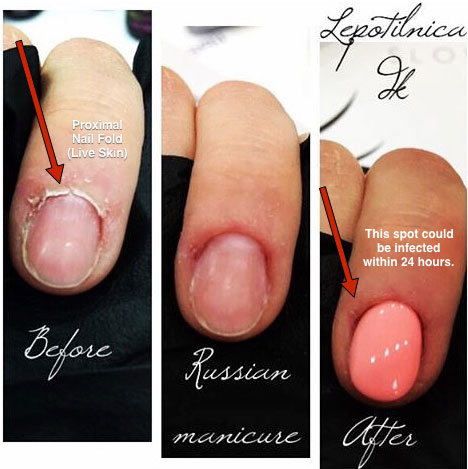
I mean, seriously, that skin looks raw!
In my first post on Russian Manicures, I discussed a couple different Russian Manicure training videos and broke them down step by step.

In this part 2 of my Russian Manicure post, I will present to you what the experts are saying regarding this technique.

Once again, lets remember throughout this that the Eponychium (actually, we now know this should be called the proximal nail fold (PNF)) is living tissue and should never be cut. From the book "Nanotechnology in Dermatology":
"The skin bordering the proximal nail plate is called the eponychium. It does not end at the nail plate, but instead folds back underneath to create a tight seal which prevents pathogens or contaminants form gaining access to the matrix area... [It] serves to help protect and cushion the matrix. This tissue is often mistakenly confused with the cuticle... The cuticle is a vital part of the seal that protects the matrix from pathogenic invasion, which explains why this area should be treated with care when manicuring."
So, what happens when the "Russian manicure" technique is done on a client? Just like with calluses on feet, the more you cut the PNF , the harder than thicker it will grow back trying to protect itself.

Vitaly Solomonoff, founder and president of the Academy of Nail Art and former editor of Nail Spa magazine in Russia, and his colleagues have studied more than 300 cases of people who have had Russian Manicures. They found that 91% of clients who constantly get the Russian manicure have symptoms of the damaged nail matrix or nail bed. "Only 9% of the cases have been determined as safe and “successful” in a long-term period of study (38 months). All 9% of clients have got the manicure from NTs with basic medical education. So, we come to conclusion that deep understanding of the processes in lively skin helps to train the correct technique of this manicure.... Symptoms may not appear right after manicure is performed, the first symptoms occur months after due the constant repetitive traumatization of the cuticle/matrix area. Symptoms include all signs of matrix/nail dystrophy from splitting, horizontal ridges, slow nail grow to the painful neuropathy and high sensitivity. We have also discovered that infectious inflammations are a common issue in those clients who has compromised immune system – diabetics etc....Imperceptible vibration always takes place even with high end e-files and impacts the highly sensitive matrix area and leads to dramatic postponed issues. The technique that may look safe and easy can bring troubles in the future...We strongly believe that micro cracks of the skin are inseminated with bacteria during few hours after the procedure. "

In addition, Solomonoff has said that "The background of the so called 'Russian manicure' is an attempt of e-files distributors to sell their units in Russia. That is why it has been widely advertised as a safe and 'healthy' alternative to clipping the nail cuticles. We, at my company have always stood against this practice unless NT has at least basic medical education and full understanding of Anatomy and Physiology of the nail unit."


Doug Schoon says "Hopefully, this problem may be self-correcting. When those who use these methods start seeing the reported problems associated with these types of manicures, hopefully they'll wake up and smell the coffee. Excessive damage to the skin around the nail plate, excessive regrowth of hardened callus-like tissue, redness, pain, puffiness, weeping/ water-blisters, itching... these are symptoms I'd expect many will see. Not only can this method cause the expected hardening and rapid/excessive regrowth of tissue, the damaged skin is more likely to develop infections. And, product-related skin irritations or allergies are more likely as well. Invaders beware- watch closely for these issues- and don't blame the products- blame your techniques. I'm already hearing of and seeing these problems."

Whatever, My Clients have had No Problems and LOVE the results

The reason your skin feels "softened" after a Russian Manicure is because the electric file wears away layers of  the epidermis - the very layers that work to keep your skin hydrated - and reveal the new, vulnerable skin underneath - often this can even be the dermis layer of the skin, which is not mean to be exposed to the elements.

Remember, you don't have to bleed in order to suffer damage and damage cannot always be seen by the naked eye. An electric file spins at thousands of revolutions a minute. You can be as light handed as you like but you will still cause damage to the natural nail.

Plus it goes against every principle of good nail health and proper technique.

But, other people are doing it!

And if they were all jumping off a cliff, would you do that too?  

Seriously though, here's the thing - if you are in the United States (and many other countries with regulations on the nail industry), the Russian manicure is a technique that is NOT approved by regulatory agencies nor is it covered under insurance company polices (which means a serious financial risk if you perform the service!). Unregulated countries may be 'allowed' to perform this technique ONLY because there are no licensing requirements or regulations. But even if you can so it doesn't mean you should do it.

Educating your clients about the dangers of the technique and encouraging them to share the knowledge with their friends will help reduce the popularity. Yes, there will still be people who "don't care" and will still seek out the service, but for every person we can educate about the dangers, that is one less person seeking out the service and one less person with damaged nails and skin. We do what we can.

What should we be doing instead?

Regular (preferably weekly) manicures using hydroxy acid based exfoliation products and hydrating masks coupled with a good quality cuticle oil twice a day will take a few weeks but you will see a massive improvement without any mechanical intervention.


References:

https://schoonscientific.com/wp-content/uploads/2017/07/May-17-Doug-Schoon-column.pdf
http://www.newnailcreations.com/links
http://www.salongeek.com/threads/russian-manicure-technique.297841/
https://www.nailcarehq.com/russian-manicure-dangerous/
https://www.nailcarehq.com/the-dangers-of-the-russian-manicure/
https://www.facebook.com/athena.elliott1/posts/10210980427719423


Monday, May 1, 2017

Once and For All, UV Lamps are SAFE

In November, 2008, a study was published that claimed that UV Nail Lamps caused cancer. In this study two healthy women with no family history of skin cancer developed melanoma after repeated use of nail salon UV lamps. Of course, the internet grabbed on to this story and ran with it. The problem is, the study was faulty. First of all, the sample size was 2 people. Two. Both who live in Texas - which, if you don’t know, is a very sunny southern state in the US. The study also made faulty conclusions based on the UV output of tanning beds, which are significantly stronger than the UV output of nail lamps and they assumed the UV-A energy exposure from nail lamps would fall within the estimated range determined to be potentially carcinogenic.
Since then, at least three additional studies have been completed, all coming to the conclusion that UV Nail lamps are indeed safe.
The Lighting Sciences study in 2010 concluded that “UV-B output is less than what occurs in natural sunlight and is equal to what a person could expect from spending an extra 17 to 26 seconds in sunlight each day during the two weeks between nail salon appointments” and “UV-A exposure is equivalent to spending an extra 1.5 to 2.7 minutes in sunlight each day between salon visits, depending on the type of UV nail lamp used.”
In December, 2012, The Massachusetts General Hospital /Alpert Medical School at Brown University study concluded that "Nail lamps are safe for over 250 years of weekly manicures, and even then there would be a low risk of skin cancer”. They also concluded that “Although some sources of UVA and UVB contribute to the development of KCs [keratinocyte carcinoma], UV nail lamps do not appear to significantly increase the lifetime risk of KC. Dermatologists and primary-care physicians may reassure patients regarding the safety of these devices.”
Testing by Sayre and Dowdy in July 2013 found that found that UV nail lights were even safer than expected. “All of the various UV nail lamps submitted for evaluation were found to be significantly less hazardous than might have been anticipated based on the initial concerns raised…” They also confirmed that UV nail lamps are NOT equivalent to tanning beds or indoor tanning lamps, largely because nail lamps use vastly different types of UV bulbs which produce different ranges of wavelengths with significantly lower intensities.
In addition, “The study demonstrates that UV exposure is so low that a worker could put their hand under a UV nail lamp from this study for 25 minutes each day without exceeding established internationally accepted safe limits or ‘permissible daily exposures’.”
In numerous interviews and research, Dr. Sayre has stated that the use of UV nail lamps does not contribute to the risk of getting skin cancer and that the emissions from UV nail lamps are safer than that of natural sunlight.
In 2013, The Skin Cancer Foundation put out an official statement that “even the most intense of these devices presents only a moderate UV risk – a far lower risk than that presented by UV tanning devices”. Of course, to play it safe, they still recommend sunscreen, as they do with any UV exposure.

So, in conclusion, UV lamps are completely safe. There is no evidence that these lamps cause cancer and there has never been a cancer case proven to have come from these lamps in the 30+ years they have been in use. You may wish to mitigate risk by wearing sunscreen if desired.

Thursday, November 5, 2015

MMA: Methyl Methacrylate

In 1954, dentist Fred slack accidentally created acrylic nails when he repaired a broken fingernail with some products he had lying around the office. At that time, Methyl Methacrylate (MMA) was a common monomer used for dental prosthesis and that is what he used for his fingernail.  This, of course, led to it being the monomer of choice for nail technicians of the time.
 
Fast forward to the 1970's. The FDA ( US Food and Drug Administration) was receiving numerous complaints about nail injuries and allergic reactions and decided to issue its first ban on MMA for use in nail products.  At that time, manufacturers voluntarily took MMA out of their formulations and the FDA did not pursue further legal tactics.  However, no specific federal law was ever enacted prohibiting the use of this chemical in nail formulations which led to new manufacturers deciding to sell it.  Since the late 1990's most states (though not all of them) in the USA have banned the substance for use in their state, but of course that doesn't stop unscrupulous salons from obtaining and using it.
 
In September 1996, in a letter written to the Nail Manufacturers Council , the FDA stated “We continue to believe that liquid methyl methacrylate, when used in cosmetic fingernail preparations, is a poisonous and deleterious substance. Generally speaking, the agency is prepared to consider regulatory action against fingernail products formulated with liquid methyl methacrylate monomer as one of its ingredients.”   
 
Also referred to as "dental acrylic" or "porcelain nails", MMA is cheap - up to 1/3 the price of EMA (Ethyl Methacrylcate - the "good" acrylic monomer) and is often used to keep costs down in shops with low profit margins.
 
One more note - MMA is only a problem in the acrylic monomers (liquid) NOT the polymers (powder) and NOT with true gels or wraps.
 

Facts

MMA is not intended for soft tissue, it is used to repair bones and teeth - and dental prosthetics are cured outside the body so therefore never come in contact with the soft tissue.  MMA is also used in road markers and plexiglass signs.
 
 
Reasons not to use MMA From Doug Schoon:
  • "Reason 1. My research shows that MMA has terrible adhesion to the natural   nail. The only way to make it stick is to severely abrade the nail, which   weakens the nail plate tremendously. Any product will stick well if you   shred up the nail plate, even MMA.
  • Reason 2. MMA creates enhancements that are stronger than the natural nail.   In other words, too strong! If an MMA enhancement is jammed hard enough the   weakened nail plate often breaks and bleeds, instead of the product   cracking. That's bad news! When designing a nail enhancement product, my   premiere goal is to make the product weaker than the natural nail, to  prevent serious nail plate damage. MMA does the opposite.
  • Reason 3. MMA cannot be easily removed from the nail plate, in fact it's   very difficult. MMA is insoluble in all safe solvents, i.e. acetone.   Because of this, MMA is usually ripped off the already thin, weak damaged   nail. This can lead to severe nail infections and severe nail plate damage. It can even cause permanent injury to the nail bed and plate. Look   around at all the damaged MMA nails, now you know why!"
 
    Issues for Nail Techs:
  • Chronic (long term) health effects can occur at some time after exposure to Methyl Methacrylate and can last for months or years
  • Repeatedly breathing in the vaports can cause symptoms such as "pins and needles", numbness, weakness, and changes in the ability to remember and concentrate.
  • Exposure can irritate the eyes, skin, nose, and throat - High exposures can cause you to feel dizzy and lightheaded 
 

Fiction/Myths

From Doug Schoon:
"Unfortunately, most people who talk about MMA don't understand the issues.  Most of the misinformation about MMA is being spread by misinformed nail techs and those who have a financial interesting in clouding the issue with lots of bogus, scientific sounding arguments.

  • Myth 1- "There is nothing wrong with MMA. The "big" companies are jealous and just trying to put us little guys out of business."  If that were true, why don't the "big" companies make an MMA product and  really put them out of business? I could make a MMA product that be many  times better than anything on the market. I don't for two very good   reasons, 1). The FDA says don't use MMA monomer and 2) MMA monomer isn't a  good nail product ingredient (and I have many years of research, observations and experiences to back up that claim.)
  • Myth 2- "MMA is just a safe as EMA" and people who are trying to scare you about EMA say "EMA is just a dangerous as MMA". Here's the trick- this   isn't even the issue! It's designed to fool you away from the real issue. MMA isn't dangerous to nail technicians health. Neither is EMA. Workers in   hundreds of types of industries use both of these monomers and there are   reams of studies which support the fact that both monomers are safe to nail   technicians (but sadly not for clients). Remember, any chemical CAN be dangerous. Vitamins CAN be dangerous chemicals. Water CAN be a dangerous   chemical. Wine CAN be a dangerous mixture of chemical. The question is, are   they dangerous when used correctly? The answer is no. MMA is no more "dangerous" than EMA and... EMA has TWICE in seven years been declared safe  to use by the highly prestigious CIR expert panel of world renown dermatologist, toxicologists and doctors (and the FDA agreed with the   finding). Give me a break, how much more proof does it take? Here is the   real issue. MMA is used in bone cements. It's perfectly safe for that use.   But, the properties that make it great bone cement, makes it a terrible   nail enhancement product which damages the nail plate and bed. 
  • Myth 3- "MMA and EMA cause liver damage, kidney damage..., etc". Hey, what   doesn't? Especially if you really overexposure yourself, all sorts of   things can happen. You could die from eating too much baby food. Fact: Under the conditions nail tech use these products, they are safe and will  not cause any these problems related to long term, mass overexposure. Anyone can come up with a list of all the things a chemical CAN do, even water! Water CAN kill you... if you stick your head in a bucket of water  for five minutes (don't try this at home <g>). "

  Other Myths/Misinformation
  • Methyl Methacrylate has not been proven to cause cancer.
  • MMA does not "eat through the nail bed", though the severe roughing up of the nails that is required for it to stick will cause damage.
  • Methyl Methacrylate has not been proven to cause lung damage (though overexposure can cause symptoms listed above in the Facts section).
  • There is no proof it will damage a developing fetus.

Signs of MMA Use

  • Strong odor that physically affects you. Beauty services involving chemicals often have offensive odors, like perms. However, while the smell may offend you, it should not physically affect you. If you experience any tightness in your throat or chest, tingling in your fingers, lightheadedness, dizziness, or an odd taste in your mouth, it is possible that MMA is being used - this odor doesn’t smell like other acrylic liquids and is often described as a "fruity" odor.
  • Ammonia-like odor when filing cured product (for fill-ins or repairs)
  • Enhancements which are extremely hard and very difficult to file even with coarse abrasives.
  • Enhancements that will not soak off in solvents designed to remove acrylics (or take a very, very long time to soak off and when they do turn gummy rather than flakey like EMA).
  • Cloudy or milky color when cured.
  • MMA turns yellow after time, "requiring" the client to get a new full set periodically.
  • Unlabeled containers – technician will not show or tell the client what brand of product is being used (this one is not "proof" necessarily but should make you question why they won't show you)
  • It used to be said that if you were paying significantly less than the "normal" price for acrylic nails then you should suspect MMA (becasue MMA costs so much less than EMA), however nowadays there are many techncians using EMA who have priced their services to compete with the discount salon segment, so this "sign" of MMA is no longer necesarily true, though it is not a bad idea to always question how a salon can be significantly cheaper than their competetors.
 
 
References/Resources
http://www.nailsmag.com/article/108385/easing-the-transition-to-ema

Monday, October 5, 2015

Nails Don't Breathe!

One of the most prevalent myths about nails - and one that is sadly perpetuated to this day by nail technicians - is the myth that nails breathe.

"Breathe" is defined as: to take air, oxygen, etc., into the lungs and expel it; inhale and exhale;respire.

"Respire" is defined as: to inhale and exhale air for the purpose of maintaining life; breathe.

This myth makes no sense on many levels! Nails aren't alive and don't have lungs nor do they have any ability to absorb air into the nail plate. The nail plate is created from nutrients that are delivered by the blood stream to the nail matrix. Cosmetic scientist Doug Schoon explains that "100% of the oxygen needed by the nail matrix to create a new nail plate comes from the blood stream and 0% comes from the outside world".  Blood brings oxygen and nutrients to the hand, fingers, and nails through millions of tiny blood vessels which also carry waste and carbon dioxide way. This intricate process is what feeds the matrix, so that it can produce healthy nail cells.  In short, nails do NOT require an external air supply and do not breathe or exhale.

Taking a break from nail polish or enhancements (acrylic, gel, etc) for a few weeks is not at all necessary.  Doug explains that while wearing enhancements, "moisture and natural nail oils leave the nail bed and pass through the nail plate at a slower than normal rate but they aren't trapped by the product." "The nail plate's moisture content is increased by increased 10-15%, and the oil content increases only slightly; both serve to increase the flexibility of the natural nail plate". Since the nails do not need to "breathe", no benefit is gained by waiting to reapply any type of nail coating. Nor does it make sense to assume the nails only need to breathe "every once-in-a-while". This faulty reasoning is not supported by the facts.

  • Neither "air" nor "nutrients" can be absorbed or "fed" to the nail plate from any external source. 
  • Moisture and natural nail oils leave the nail bed and pass through the nail plate at slower than normal rates, but they aren't "trapped".  
  • Waste products are removed from the matrix area and surrounding tissues by the blood as well, and are not released into the nail plate. 
  • Normal, healthy nail plates would continue to grow and thrive in a completely air-free environment, as long as a healthy flow of blood to the nail is maintained.

TL;DR
The natural nail plate is not living - and it does not breathe. Because it is made up of non-living keratin, it does not hurt to have your nails clipped – the same reason that it doesn’t hurt to have your hair cut. The nail plate is healthy when the health of the nail bed, matrix and surrounding tissue are properly cared for - it does not need to “breathe” to be healthy.


Resources:
http://schoonscientific.com/downloads/Myths-from-FB_2013-03-14.pdf
http://www.nsinails.com/nail-lab/science-of-beauty/dispel-the-myth-nails-donrt-need-to-breathe.html#.Vg2M93LltaQ
http://www.nailsmag.com/blogpost/108013/save-the-nails-with-the-nail-snorkel
http://www.nailcarehq.com/huffington-post-false-nail-info/

Waterless Manicures

The very first thing a nail tech learns in school is a basic manicure.  Its pretty easy - shape the nails, soak the nails in warm soapy water, push back cuticles, apply lotion and polish.  This type of manicure has been going on forever! Well, what if I told you that this procedure is the basis for a number of problems that manicurists experience all of the time (from peeling nails to chipped polish and more)?
 
 
Now we all know the basics of nail structure. But how many of us realize that the nail plate isn't a solid structure?  It is made up of a lot of cells that were produced in the matrix and then flattened out into sheets as they grow to form the nail plate. If you were to look closely at the plate (with a microscope) you would see it isn't a solid structure, rather it is full of nooks and crannies - kind of like a sponge.
What happens to a sponge when you immerse it in water?  It fills its nooks and crannies with water and expands.  Depending on the original shape of the sponge, it can even change shape after soaking in water.
 
Now, if you were to coat said sponge in, say, nail polish, while it is still damp, what might happen when the sponge eventually dries out once again (which takes some time)?  At that point the polish is dry and the sponge has shrunk away from the dried coating, causing it to chip.  And the thinner the sponge, the more distorted the difference between wet and dry.
 
Lets look at another analogy. Wood is similar in structure to a nail plate as well, in the fact that it is made up of layers.  What happens to wood when you leave it out in the rain contently?   The repeated wet-expand-dry-shrink cycle causes the wood to split and splinter.
 
 
Do you see where I am going with this???  Repeated expansion and contraction of the nail plate when repeatedly exposed to water causes stress on the plate and eventual weakness, splitting, peeling and chipping polish.   The thinner a clients nails the more the nail will expand and contract causing even more damage (which is also why some people with really hard nails never seem to have problems no matter what they put their hands into!)  Water is classified as a solvent for a reason -  repeated exposure dissolves things (Grand Canyon anyone?).
 
Back in the day when people first started offering manicures as a service, there was not a nail industry.  They did not have a million cuticle removers an lotions and oils available to them so warm soapy water was used to soften the cuticle.  Water is damaging to the natural nail and there is no reason to soak the fingers in water any more. Nowadays we have many preparations that work better than soapy water to soften cuticle and do not swell up and damage the nail plate.  Water based manicures are obsolete technology.
 
Basic Waterless Manicure Procedure
  1. Shape Nails
  2. Apply cuticle remover and push back/detail cuticles
  3. Remove cuticle remover per manufacturers instructions (this may entail having a spray bottle of water at your table but spraying and wiping is vastly different than soaking nails in water).
  4. Apply lotion
  5. Cleanse nails and polish
 
As for clients, they need to do their part at home. 
  • Use gloves when washing dishes or other cleaning chores. 
  • Use a good cuticle oil on the nail plate to help keep it supple (think of cuticle oil as a car wax - it helps keep the elements from soaking into the car/nail). Make sure it is a good natural oil and not mineral oil - mineral oil has too big of a molecule to penetrate the nail plate.
  • After showering or bathing, they need to be gentle with their hands to avoid breaking or chipping a nail that is full of water and weak.


For more information:


Sunday, October 4, 2015

Acetone and Other Solvents

The below post was taken from a response that Doug Schoon posted on a forum in 2001
----
Here are the chemical facts. Water is the safest solvent in the nail industry. Yes water is a solvent! In fact, water is called the "universal solvent" because it dissolves more
things than any other known substance.

The second safest solvent used in salons is acetone. That's why its sold for this purpose. Oh, there are much faster acting solvents, but they aren't safe enough for salons. Why is acetone so safe? Acetone evaporates quickly, but the vapors don't exceed safe levels in salons. The air levels are at LEAST five times below OSHA maximum safe limits for long term, workplace exposure. How do you know if there is too much acetone in your breathing air? I bet you wouldn't stay in a room with unsafe levels of vapor. Your eyes would burn and flood with tears long before you reached unsafe breathing levels. Because of this fact, scientists say that acetone has "good warning properties" that limit exposure. If there is ever too much in the air, you'll know it and probably do something about it. Therefore, it is very unlikely that nail technicians could become overexposed to acetone vapors in the nail salon. Even better, it is even less likely for the clients to be overexposed, so tell them not to worry about it. Acetone is NOT suspected to cause cancer by any credible government or scientific agency, including the FDA, Center of Disease (CDC) and the World Heath Organization (WHO). If this were true, it would not be allowed or used in the professional nail industry.

What about skin absorption? Facts: Removing nail polish is very safe. Only extremely small amounts of acetone will even penetrate the top layers of the skin. Most of it evaporates and dissipates quickly from your warm skin or nails. None of the acetone will pass into the dermis or basement level of the skin. None will pass through the nail plates. So, clearly it can't absorb into the blood stream. A client soaking in acetone while removing artificial nails can have tiny amounts of acetone absorb into the blood, but the exposure is very safe... far, far below the maximum safe exposure limits.

What's the extreme exposure possibility? A client removing artificial nails, soaking all ten fingers in acetone for one hour, acetone in a dish and up to the knuckle, repeated once every three months. Gulp! Most would agree this represents the maximum exposure or worst-case scenario (of course, don't try this in your salon! Product shouldn't be removed unless necessary. Some clients successfully wear them for years without ever removing them). Even at this worse possible exposure, client's are far, far below the maximum safe limits of exposure. This is why I say that normal salon use of acetone is very safe! My fifteen years of studying chemicals and their use in salons has absolutely convinced me this is true. Fact: The major hazard with acetone is fire. Be careful how you store and use acetone. Keep it away from excessive heat and away from any flames or microwaves or cigarettes, etc. Learn how to use acetone from your supplier. It is their responsibility to provide you with this information. Also, keep all of you professional salon products away from children at all times, including acetone!

Everything I said above also applies to non-acetone products. These products use a different, but similar solvent called ethyl acetate. Of course, this solvent can also be used safely in the salon. But, it is a myth that non-acetone products are safer than acetone. Acetone is slightly safer than ethyl acetate, according to OSHA data and other scientific information. If you are interested, you can also find a whole lot more information in my book on the subjects of solvents, inhalation, keeping the salon air healthy, overexposure, etc. Lastly, both acetone and ethyl acetate can be drying to the skin. They are such a good solvents- they can rob the skin of its natural oils- voila- dry skin. So, use a good lotion or moisturizer oil after you use either of these solvents. This will help combat dryness problems with nails and skin. You'll be amazed at how much a good lotion, cream or moisturizing oil will help to restore and protect your skin and nails. To prevent over dryness, work professionally and limit your skin and nail exposure whenever possible. For example, discuss and learn about "speedy" product removal techniques from co-workers or net buddies. Use plastic back cotton pads, to prevent drying of your finger tips and avoid cleaning your skin with a solvent stronger than good ol' water. Hope this information helps.

Bye for now,

Doug Schoon


Friday, October 2, 2015

Common Nail Disorders: Chloronychia aka "Greenies" (Pseudomonas Aeruginosa)

Your favorite clients walks into the salon. You are chatting while you remove her nail polish and she is telling you how she was gardening all weekend and now has a bunch of zucchini and she asks if you would like her to bring you some. You say "That would be great!" and look down at her nails......one of which is as green as the zucchini she was talking about! What in the world happened and how do you fix it?


What are "Greenies"?
Pseudomonas aeruginosa is a common bacteria that can cause disease in plants and animals, including humans. It is found in soil, water, plant, pets, skin flora, and most man-made environments throughout the world. When it grows, it's waste produces pigments that impart the green color of chloronychia (the technical term for green nails caused by p. aeruginosa bacterium).
Normally, nail plate and nail bed are not hospitable places for the bacteria, but if they have become compromised in some way, then the pseudomonas can find a home. It feeds off the dead tissue in the plate of the nail and this is what causes the separation of the nail and nail bed. Chloronychia can occur between the natural nail plate and the nail bed or between an artificial nail coating and the natural nail plate. Some people mistakenly categorize chloronychia as a mold, but in reality mold is not a human pathogen.

How Do You Get It?
This bacterium flourishes in wet environments, such as Jacuzzis (where it can cause a rash), swimming pools (where it can cause swimmer's ear), contact lens solution, sinks, and bath sponges. Because it thrives on moist surfaces, this bacterium is also found on and in medical equipment, including catheters, causing cross-infections in hospitals and clinics. 

In a salon environment,  the vast majority of infections that occur on nails with no signs of lifting are often caused by the nail tech, according to Doug Schoon. For example, if a client touches her nails to her face and the nail plates aren’t re-cleaned the chances of an infection go up tremendously. That’s why it’s important for both nail techs and clients to wash their hands before every service. Nail techs should also individually clean the nail plates just before applying product. If you get rid of surface moisture and oils (and the bacteria) before product is applied, it will be highly unlikely for your client to get infections. "They're all over us," explains Schoon. "We typically carry hundreds of species of bacteria on our skin at any time, depending on what we're in contact with."  Improper application can lead to lifting, which can allow bacteria to get under the area where the product has separated.

"On rare occasions pseudomonas aeruginosa can cause serious infections, particularly of the eyes, so good sanitation and disinfection practices are important for more than just cosmetic reasons," says Vicki Peters. "An untreated greenie can turn into a black/brown nail and can cause the client permanent [nail] damage."


Treating Chloronychia under the Natural Nail
if the infection is under the natural nail it is usually a secondary infection and the client must be referred to a medical doctor who can treat the bacteria and clean up the nail

Treating Chloronychia under Nail Enhancements
It is best to keep nails short and free from enhancements if a Pseudomonas aeruginosa infection is suspected.  Instruct your clients to come to you if they experience lifting and not to attempt to take care of the problem themselves by gluing down the lifted area which will trap any bacteria present.

It is possible to work on a client with pseudomonas. According to Dr. Phoebe Rich, the infection is not easily transmitted from person to person in a salon. However, as a precaution, once you use a file on an infected nail, don’t use it on another nail. Wrap it in plastic wrap and toss it in the trash.

To help rid the nail plate of the infection, remove the enhancement, lightly buff the stain to open up the nail plate cells, and remove all moisture and some of the surface oils. Instruct the client to keep the plate clean and dry at all times, and wear gloves when having her hands in water or using household cleaning solutions.

"Pseudomonas will often spontaneously disappear when the underlying nail problem is cleared up. There are several home remedies that will treat pseudomonas very effectively. The simplest treatment is to use diluted white vinegar soaks (1 part vinegar to 2-4 parts water) for several weeks. You can store the solution in a dropper bottle and apply one drop under the nail twice a day. To remove the discoloration, the nails can be rinsed in a diluted bleach solution (1 part bleach to 4 parts water) once or twice, but not for prolonged periods. If these simple remedies fail, a doctor can prescribe antibiotics for resistant cases." — Dr. Phoebe Rich

Ultimately, the nail but be cleaned, disinfected, and have any enhancements removed. But remember, you are a nail tech, not a doctor. If it looks like there is an infection present, do not risk trying to rectify the clients' problem. In most cases, it is actually illegal for a tech to work on nails that appear to be infected. Instead, at this point, you must refer your guest to a medical doctor who can treat the bacteria and clean up the nail


What if We just "leave it alone"
All pseudomonas infections can make you very sick if they spread through the bloodstream. A serious infection can cause symptoms of high fever, chills, confusion, and shock. If the infection spreads to critical body organs, such as the lungs, the urinary tract, and kidneys, the results can be fatal. The infections are hard to treat because the bacteria can resist many types of antibiotics


References
https://en.wikipedia.org/wiki/Pseudomonas_aeruginosa
http://www.nailsmag.com/article/40049/pseudomonas
http://www.aocd.org/?page=GreenNailSyndrome
http://www.nailpro.com/germs-keep-out
http://www.beautyweb.com/Ask_the_Experts/Nails/nail_fungus.htm

Sunday, September 20, 2015

Fiberglass, Silk and Linen Wraps

Developed in the early ‘80s, nail wraps are thin products made from paper, silk, linen, fiberglass, mesh, or other fabrics applied to the nail for extra reinforcement.  Fabric nail wraps used to be one of the "big" nail enhancements. Nowadays many nail techs aren't even taught them in school! 

However, as clients are moving toward a more natural nail and the trend is short, many nail techs are using nail wraps as a way to give their clients stability while still maintaining a very thin, natural look. Nail wraps are great for clients who are allergic to acrylic or primer, clients who are looking for a very thin nail enchantment, and natural nail repairs. Nail wraps are also great for clients who are giving up acrylics and want to grow out their nails. “When you have acrylics, you don’t have to be too careful with your hands,” says Elaine Watson. “If you reach for something and bang your nail, it probably won’t break. But when you’re going back to natural nails, this can be shocking. When wearing nails with an overlay, you’re going to tend to adjust to them better as they’re growing out.”


The Chemistry of Wraps 
by Doug Schoon, excerpted from http://www.hooked-on-nails.com/chemistry.html

The monomers used to create wraps are called cyanoacrylates and are members of the acrylic family. They are the same monomers used to create many fast setting adhesives such as Krazy Glue.® Professional nail products are specifically designed for use on fingernails and are far superior for this application. These monomers are sensitive to alcohol, water, and weak alkaline substances, and in large amounts they can cause almost-instant polymerization. A drop of water or alcohol on wrap monomers will cause ‘shock cure”. They will harden quickly and turn cloudy white. They turn cloudy because shock curing causes thousands of microscopic crack. They are invisible to the eye, but the cracks will scatter light reflecting from the surface. Small amounts of these substances cause slower, controlled reactions which result in polymers which are clear, flexible and strong. Wraps, however, do not have the advantage of being cross-linked.

Water-sensitive monomers must be protected from moisture in the air which is why they are sold in containers with small nozzles. This prevents air molecules from gelling or thickening the product. As with other monomers, inhibitors are used to prevent gelling. Even so, leaving a container open for too long will thicken the product fairly quickly. You might think this moisture sensitivity is a negative, although it actually is a positive. The nail plate contains enough moisture to polymerize wrap monomers, and just touching the nail plate is often enough to react the monomers. (This is one reason why cyanoacrylates so easily adhere ones fingers together.)

Catalysts speed up the polymerization and reduce cure time from minutes to seconds. Spray or brush-on catalyst causes an almost-instantaneous reaction. The catalysts in wrap systems are generally weak alkaline substances which may be listed as “aromatic amines’. Rapid reactions cause rapid heat build-up. Incorrectly used, these catalysts may heat the nail plate to a blistering 170° F. A small amount of warming is beneficial and will improve strength; however, pain-causing heat may cause serious burns to the nail bed. To avoid over-heating, some catalysts must be sprayed from a distance. Always wear the proper mask when using these systems to protect yourself from the vapors of mists and sprays.

Clients who frequently wet their hands should be warned that all cyanoacrylates are moisture sensitive, and should be instructed to wear gloves whenever possible. This is true of both tip adhesives and wraps.

Choosing a Fabric:
"A lot of new techs are unsure whether they should use fiberglass or silk. I always ask the client first how tough she is on her nails. Is she breaking her nails often? Or only once in a while?  If she says she breaks her nails frequently, then I’ll go straight to a fiberglass wrap because they offer more strength — about double that of silk wraps. But if she says she only breaks or chips a nail every once in a while, then I’ll start her off with silk wraps and take it from there. If she needs more reinforcement we can switch to fiberglass." ~Backscratchers educator Christine Vargas

There are three main types of fiber traditionally used on nails:
Fiberglass: Very strong, cross-weaved fiber but mesh can be seen on the nail if you look closely
Silk: Turns completely transparent when saturated with resin, but not as strong as fiberglass or linen.
Linen: thickest fabric, opaque, very strong but rarely seen nowadays


Application Methods:
  • Tip and Overlay
  • Natural Nail Overlay
  • Natural Nail Repair
  • (Sculpting with wraps is a very advanced technique and not usually done)
Generic Application Procedure: (as always, follow the manufacturers instructions for your chosen product)


  1. PREP the nail as usual - use a very fine grit to remove shine
  2. Lay down a base of resin on the natural nail and apply accelerator as directed by your system
  3. Apply and blend tip if desired - if you are going to apply a tip lightly remove the shine from the free edge of the resin base before applying tip.
  4. Place full strip of chosen fabric on nail, cut to fit with 1/32" to 1/16" space around edges. DO NOT Touch the fabric with your fingers as natural oils will inhibit the resin from penetrating the fabric.
  5. Apply a thin resin, saturating the fabric. Spray activator.
  6. Optional: apply a second layer of fabric or just a 1/4" "stress strip" across the tip line for additional strength.  Apply a thin resin, saturating the fabric. Spray activator.
  7. Apply 1-2 additional layers of resin and activator.
  8. Use a medium-fine file to smooth the nail - do not over file.  Wraps file much easier than acrylic or gel nails.
  9. Use a block buffer and a 3 way buffer to finish the nail.  You may also apply gel polish to finish.


Wrap Removal:
Because wraps are not cross-linked like acrylics, removal time is greatly reduced.  Generally they will come off in around 10 minutes of soaking in acetone.  Of course, this means you also need to be very careful when removing nail polish on wraps and most manufacturers suggest a non-acetone remover so as not to "melt" the resin when removing polish.


Application Video


Some Brands of Wraps:


Much of this article was excerpted from: http://www.nailsmag.com/article/97861/return-of-the-nail-wrap and http://www.nailsmag.com/article/614/wrap-chat


Monday, September 7, 2015

LED vs UV lamps

LED Lamps have become "the" thing in the last couple of years - people are (needlessly) worried about UV overexposure and LED cures gel nails faster than UV. BUT many nail techs think you can just use an LED lamp in place of a UV lamp without regard to the product. In the linked article below, we learn that a properly and carefully formulated UV/LED-curing nail product requires the correct level of UV exposure in the proper range of wavelengths of the correct intensity and for the right amount of time.
In other words, use the lamp that was created to go with your product and don't assume all lamps are created equal! Even two different brands of LED nail lamps will differ in wavelength and intensity. Be safe, follow the manufacturer's instructions.

One more thing - LED is on the UV spectrum - so by using an LED lamp, you are not avoiding UV exposure.  See part 2 of this post for more info on how UV and LED are related

Primers

So we have sanitized ours and our clients hands, done a client intake, PREPped the nail and applied tips or forms (if that was what we decided to do smile emoticon ) What's next? Applying product! Generally, the first part of most product lines is priming the natural nail plate to promote adhesion, so lets discuss the ins and outs of primer.
Primer Means “First Coat”. A primer’s job is to join two surfaces that naturally do not slick together well. Whether or not you need a primer depends on your product. If you are applying Cyanoacrylate based systems (like wraps or "tip and dip" systems) or a primer-less acrylic you do not need a primer. Conventional acrylic liquid and powder *will* stick to the nails without primer, but it won’t necessarily stick very well.
The condition of your client’s nails determines whether and how much primer you need. Most manufacturers recommend a single application of primer. Clients with very oily nail beds and chronic lifting may need a second coat of primer. Some medications cause clients to have lifting problems, so those clients may need a second coat of primer.It’s best to start with a minimum of primer and only use more if the client has developed lifting. If you’ve used two coats of primer and the client still develops lifting, your preparation and application technique may be the problem. “Don’t use primer as a crutch for poor technique.” ~ Doug Schoon
Primer acts like a double sided tape - the molecule has two sides - one side is attracted to the natural nail proteins and the other side is attracted to the product.
Original primers were made of methacrylic acid (MAA - not to be confused with MMA). The artificial nail industry as a whole evolved from the dental industry and this is one of those items that came with it. It is a very reliable primer and is a super-dehydrator. MAA primer can also burn the skin, it has a strong, unpleasant odor, and it can thin the nail plate due to the etching mechanism (meaning the acid etches microscopic nooks and crannies into the nail plate). Re-priming the same area more than once doesn’t make the surface more “sticky.” In fact, over-priming with an acid based primer can damage the nail. These still exist today - Tammy Taylor and No Lift Nails are two major brands.
Non-MAA primers (aka Protein Primers) were originally developed for the veterinary industry to repair split and fractured hooves and evolved for the nail industry. It is not as corrosive to the skin and can’t enter the bloodstream via the nail bed. Non-MAA doesn’t work by etching the nail in order for the acrylic to grab hold of the nail surface. It works like a coat of adhesive. Non-MAA primer contains an ingredient that causes a temporary change in the pH of the natural nail (slightly acidic) to make it closer in pH to that of the product (highly alkaline). This pH change helps the product adhere. The nail eventually returns to its natural pH level, and the adhesive strength of the primer diminishes. (Most companies nowadays have this type of primer - CND, Young Nails, etc)
The first coat of an MAA primer should be allowed to dry completely. If you apply a second coat, depending on the particular primer you’re using, you can either wait for the second coat to dry completely, or you can apply the product while the primer is still semi-wet. Doug Schoon warns against applying product on wet primer because it can contaminate the product and cause yellowing, cracking, and bubbling. Non-MAA acid should be allowed to dry completely or its adhesive ability will be negated.
Some other tips:
- Primers should be used extremely sparingly; use just enough to dampen the natural nail. It should not flood the nail or skin in any way.
-Primers only go on the natural nail - never on tips as it can cause cracking of the plastic.
-Do not apply primer on the skin

Now what about using a primer with a primer-less liquid?
Primer-less liquids are created with covalent bonds - the strongest types of adhesive bond in nature. The result is a product that bonds the nail enhancement tightly without the need of using an Primer. What is interesting is that if you use a primer with this type of liquid, you almost always diminish the bond of the liquid to the nail. Think about it - in a traditional gel or liquid/powder acrylic system the molecules are attracted to the primer BUT in a primer-less systems the molecule is attracted to the nail - and not the primer. Which means even though the primer is trying to grab onto the product, the product wants to grab the nail instead but is being thwarted by the primer. Of course, there are some clients who just have lifting issues and prier might actually help in their cases, but they should be the exception not the rule. If you use a primer-less liquid and find you have to use primer, something else is wrong.

One more thing  - liquid primers like MAA and Protein primers are generally interchangeable. I am a big proponent of using a product system (same brand Liquid and Powder, etc) but primers are the exception. HOWEVER, when it comes to gel bonders/base gels that are UV cured, those are not interchangeable. They really are the first step of the gel system, nut a primer as defined in this post. And they can definitely not be used with liquid/powder acrylic!

Nail Adhesives

In this post I am specifically taking about adhesives used to apply tip and wraps (some tip application notes are at the bottom). The first few paragraphs came from my notes on the chapter on adhesives from Doug Schoon's Nail Structure and Product Chemistry book (aka, the nail tech bible)

Adhesion is a force of nature-molecules of one surface are attracted to the molecules of another. It is what makes two surfaces stick together. - An adhesive is a chemical that causes 2 surfaces to stick together. - Glues are made from proteins, usually animal proteins (think: Elmer's glue). (You will find that I am a big stickler for proper terminology)

Adhesion occurs when 2 surfaces are compatible - removing oils and waxes changes the nature of the surface and clean, dry undamaged surfaces allow for better adhesion. Moisture can interfere with an adhesive bond and heavy abrasives strip off the natural nail plate, leaving it thin and weak.

Nail Adhesives are cyanoacrylates - which are a class of adhesive that must be protected from air moisture as they are are sensitive to water, alcohol and weak alkaline. They are not cross-linked so they are easily attacked by polish and remover solvents. Extremely fast setting adhesives give lower strength bonds and break down faster with exposure to moisture.

So if you think of nail adhesives being on a scale of 1 - 10 with 1 being the viscosity (thickness) of water and 10 being a super thick gel, the adhesives on the lower end of the spectrum will set the fastest and break down the soonest while the thicker adhesives on the high end of the spectrum set up the slowest but also break down the slowest. I personally prefer to use a gel bond when I use tips (which is rarely) because I would rather my clients not have their natural nails separate from the tip by the first fill. Yes It takes me a bit longer to apply the tips because I have to hold them for a few seconds, but i fond it worth it. Now I know other techs who value the speed of the fast setting adhesives and that is perfectly fine. The point is to know the pros and cons and decide what is right for YOU.

As for applying adhesives on a tip, there are many ways to do it and not one it "right" or "wrong". I like to put the adhesive on the well of the tip. Others put it on the natural nail. Still others put it on both. And yet others hold the tip on the nail and use a very thin adhesive and drip it on the seam where the tip meets the nail so it "sucks" up under the tip. The most important part of applying a tip is to make sure that it is flat on the nail and that there are no bubbles in the adhesive. Bubbles mean its not adhered and can allow for bacteria to set up shop under the nail.

One more thing I should mention - "Super Glue", Nail Adhesives and medical "liquid stitches" are ALL cyanoacrylates. BUT they are NOT interchangeable! Super glue contains etching agents and is not manufactured in sterile environments. Nail adhesive is made to go on the body and is manufactured accordingly. Medical adhesives are similar to nail adhesive but are manufactured in the strictest sterile setting as they are meant to come into contact with sensitive tissues and possibly blood.

Sunday, September 6, 2015

Proper File Grit for Prepping

Lets talk about the proper grit to use on the natural nail when prepping the natural nail before an enhancement service. Yes this will be LONG!
When prepping a nail, nail technicians should only remove the shine caused by oil on the surface. If the nail plate is visibly thinner after removing nail enhancements, it is due to overly aggressive abrasives or filing techniques before the enhancement application or during a re-balance service.
Ideally nothing harsher and a 180-240 grit file should be used on the natural nail. EVER. Yes I am aware that there are companies that insist that a 100 grit file needs to be used on the natural nail to "etch" the nail. To me that says the company is either not using the latest technology ("old school" products wouldn't stick to the nail without etching) or the company is not up to date on the industry standards. 
Using a 100 grit file on the natural nail WILL damage it. Period. It might be micro-scratches, but they are scratches that weren't there before. If a product truly does not work without damaging the natural nail, I encourage you to look into other products. Here is  some great info on nail structure from (you guessed it) Doug Schoon. Also, read the quote from him below - it is so true!

Wise Words From Doug Schoon
"Let's clear something up! It's not just nail bars or non-standard salons that are damaging client's nails. I've been in high end salons and watched nail technicians over file the nail plate. I've seen top educators for major companies, over file the nail plates. Go to a trade show and watch the nail demos, and you'll see this happen all the time. Some manufacturers video demonstrate techniques that encourage over filing the nail plate. This is all too common problem in our industry. I'd venture to guess that a significant percentage of all nail techs around the world are prone to using overly aggressive filing techniques. And I guess that many of you reading this post, also over file the nail plate.
"As an industry, we got to move past blaming non-standard salons and begin to realize this is a COMMON problem in the nail industry, which means huge number of nail techs (if not most nail techs) are improperly filing and/or removing nail coatings. Sure, things were much worse in the 80s and 90s and this industry has made great strides in the last ten years. Still, the nail industry has a long way to go. Blaming some nail techs for what many nail techs regularly do will NOT solve this common problem.
"The solutions start with each of you. Nail techs should NOT be removing layers of the natural nail and when coatings are removed- there should be no nail damage. Responsible companies should NOT be teaching potentially damaging techniques which encourage over filing of the nail plate. If your client's nails show signs of nail damage, you need to look at your own techniques and not blame the products. Most of this nail damage is the caused by the nail professional, not the products."