Showing posts with label Natural Nail Structure. Show all posts

Friday, August 30, 2019

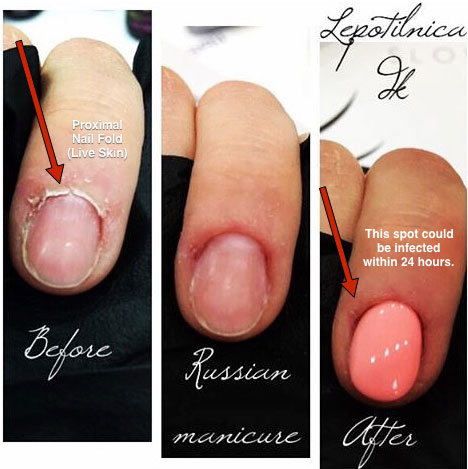
Russian Manicures Part 2 - the Consequences and Experts Weigh In

I mean, seriously, that skin looks raw!
In my first post on Russian Manicures, I discussed a couple different Russian Manicure training videos and broke them down step by step.

In this part 2 of my Russian Manicure post, I will present to you what the experts are saying regarding this technique.

Once again, lets remember throughout this that the Eponychium (actually, we now know this should be called the proximal nail fold (PNF)) is living tissue and should never be cut. From the book "Nanotechnology in Dermatology":
"The skin bordering the proximal nail plate is called the eponychium. It does not end at the nail plate, but instead folds back underneath to create a tight seal which prevents pathogens or contaminants form gaining access to the matrix area... [It] serves to help protect and cushion the matrix. This tissue is often mistakenly confused with the cuticle... The cuticle is a vital part of the seal that protects the matrix from pathogenic invasion, which explains why this area should be treated with care when manicuring."
So, what happens when the "Russian manicure" technique is done on a client? Just like with calluses on feet, the more you cut the PNF , the harder than thicker it will grow back trying to protect itself.

Vitaly Solomonoff, founder and president of the Academy of Nail Art and former editor of Nail Spa magazine in Russia, and his colleagues have studied more than 300 cases of people who have had Russian Manicures. They found that 91% of clients who constantly get the Russian manicure have symptoms of the damaged nail matrix or nail bed. "Only 9% of the cases have been determined as safe and “successful” in a long-term period of study (38 months). All 9% of clients have got the manicure from NTs with basic medical education. So, we come to conclusion that deep understanding of the processes in lively skin helps to train the correct technique of this manicure.... Symptoms may not appear right after manicure is performed, the first symptoms occur months after due the constant repetitive traumatization of the cuticle/matrix area. Symptoms include all signs of matrix/nail dystrophy from splitting, horizontal ridges, slow nail grow to the painful neuropathy and high sensitivity. We have also discovered that infectious inflammations are a common issue in those clients who has compromised immune system – diabetics etc....Imperceptible vibration always takes place even with high end e-files and impacts the highly sensitive matrix area and leads to dramatic postponed issues. The technique that may look safe and easy can bring troubles in the future...We strongly believe that micro cracks of the skin are inseminated with bacteria during few hours after the procedure. "

In addition, Solomonoff has said that "The background of the so called 'Russian manicure' is an attempt of e-files distributors to sell their units in Russia. That is why it has been widely advertised as a safe and 'healthy' alternative to clipping the nail cuticles. We, at my company have always stood against this practice unless NT has at least basic medical education and full understanding of Anatomy and Physiology of the nail unit."


Doug Schoon says "Hopefully, this problem may be self-correcting. When those who use these methods start seeing the reported problems associated with these types of manicures, hopefully they'll wake up and smell the coffee. Excessive damage to the skin around the nail plate, excessive regrowth of hardened callus-like tissue, redness, pain, puffiness, weeping/ water-blisters, itching... these are symptoms I'd expect many will see. Not only can this method cause the expected hardening and rapid/excessive regrowth of tissue, the damaged skin is more likely to develop infections. And, product-related skin irritations or allergies are more likely as well. Invaders beware- watch closely for these issues- and don't blame the products- blame your techniques. I'm already hearing of and seeing these problems."

Whatever, My Clients have had No Problems and LOVE the results

The reason your skin feels "softened" after a Russian Manicure is because the electric file wears away layers of  the epidermis - the very layers that work to keep your skin hydrated - and reveal the new, vulnerable skin underneath - often this can even be the dermis layer of the skin, which is not mean to be exposed to the elements.

Remember, you don't have to bleed in order to suffer damage and damage cannot always be seen by the naked eye. An electric file spins at thousands of revolutions a minute. You can be as light handed as you like but you will still cause damage to the natural nail.

Plus it goes against every principle of good nail health and proper technique.

But, other people are doing it!

And if they were all jumping off a cliff, would you do that too?  

Seriously though, here's the thing - if you are in the United States (and many other countries with regulations on the nail industry), the Russian manicure is a technique that is NOT approved by regulatory agencies nor is it covered under insurance company polices (which means a serious financial risk if you perform the service!). Unregulated countries may be 'allowed' to perform this technique ONLY because there are no licensing requirements or regulations. But even if you can so it doesn't mean you should do it.

Educating your clients about the dangers of the technique and encouraging them to share the knowledge with their friends will help reduce the popularity. Yes, there will still be people who "don't care" and will still seek out the service, but for every person we can educate about the dangers, that is one less person seeking out the service and one less person with damaged nails and skin. We do what we can.

What should we be doing instead?

Regular (preferably weekly) manicures using hydroxy acid based exfoliation products and hydrating masks coupled with a good quality cuticle oil twice a day will take a few weeks but you will see a massive improvement without any mechanical intervention.


References:

https://schoonscientific.com/wp-content/uploads/2017/07/May-17-Doug-Schoon-column.pdf
http://www.newnailcreations.com/links
http://www.salongeek.com/threads/russian-manicure-technique.297841/
https://www.nailcarehq.com/russian-manicure-dangerous/
https://www.nailcarehq.com/the-dangers-of-the-russian-manicure/
https://www.facebook.com/athena.elliott1/posts/10210980427719423


Monday, October 5, 2015

Nails Don't Breathe!

One of the most prevalent myths about nails - and one that is sadly perpetuated to this day by nail technicians - is the myth that nails breathe.

"Breathe" is defined as: to take air, oxygen, etc., into the lungs and expel it; inhale and exhale;respire.

"Respire" is defined as: to inhale and exhale air for the purpose of maintaining life; breathe.

This myth makes no sense on many levels! Nails aren't alive and don't have lungs nor do they have any ability to absorb air into the nail plate. The nail plate is created from nutrients that are delivered by the blood stream to the nail matrix. Cosmetic scientist Doug Schoon explains that "100% of the oxygen needed by the nail matrix to create a new nail plate comes from the blood stream and 0% comes from the outside world".  Blood brings oxygen and nutrients to the hand, fingers, and nails through millions of tiny blood vessels which also carry waste and carbon dioxide way. This intricate process is what feeds the matrix, so that it can produce healthy nail cells.  In short, nails do NOT require an external air supply and do not breathe or exhale.

Taking a break from nail polish or enhancements (acrylic, gel, etc) for a few weeks is not at all necessary.  Doug explains that while wearing enhancements, "moisture and natural nail oils leave the nail bed and pass through the nail plate at a slower than normal rate but they aren't trapped by the product." "The nail plate's moisture content is increased by increased 10-15%, and the oil content increases only slightly; both serve to increase the flexibility of the natural nail plate". Since the nails do not need to "breathe", no benefit is gained by waiting to reapply any type of nail coating. Nor does it make sense to assume the nails only need to breathe "every once-in-a-while". This faulty reasoning is not supported by the facts.

  • Neither "air" nor "nutrients" can be absorbed or "fed" to the nail plate from any external source. 
  • Moisture and natural nail oils leave the nail bed and pass through the nail plate at slower than normal rates, but they aren't "trapped".  
  • Waste products are removed from the matrix area and surrounding tissues by the blood as well, and are not released into the nail plate. 
  • Normal, healthy nail plates would continue to grow and thrive in a completely air-free environment, as long as a healthy flow of blood to the nail is maintained.

TL;DR
The natural nail plate is not living - and it does not breathe. Because it is made up of non-living keratin, it does not hurt to have your nails clipped – the same reason that it doesn’t hurt to have your hair cut. The nail plate is healthy when the health of the nail bed, matrix and surrounding tissue are properly cared for - it does not need to “breathe” to be healthy.


Resources:
http://schoonscientific.com/downloads/Myths-from-FB_2013-03-14.pdf
http://www.nsinails.com/nail-lab/science-of-beauty/dispel-the-myth-nails-donrt-need-to-breathe.html#.Vg2M93LltaQ
http://www.nailsmag.com/blogpost/108013/save-the-nails-with-the-nail-snorkel
http://www.nailcarehq.com/huffington-post-false-nail-info/

Sunday, September 6, 2015

Nail Growth and Structure

Understanding the structure of the natural nail is important for a number of reasons. One, you want to know what you are working with. Two, you want to be able to talk professionally about your job. Three, many professional nail companies use proper terminology and you want to be able to understand what they are talking about.
One of the most misunderstood aspects of nail structure is the cuticle - I wrote a post comparing cuticle/eponychium /pterygium 
Personally I find the mechanism of nail growth fascinating - you can see in the picture below that the nail grows up from the matrix and as it is pushed out onto the nail plate, it collects dead skin cells from the eponychium - this is what is called true cuticle. The cells that are produced in the matrix are soft and round and as the gather and start being pushed up to the nail bed they are flattened into layers and become harder. One interesting bit of trivia is that the lunula (the white "moon" at the base of some people's nails) is actually the top edge of the matrix. The size of your lunula is due to the position of your matrix on your finger - absolutely nothing can change that (I have heard of people saying "just push back your cuticles"....yeah...no.)
You may ask yourself - how does the nail plate stay on the nail bed? Take a very, very close look at your nail bed (assuming you don't have polish on!) and you will see little "lines" that run the length of the nail - also seen in the third picture below. These lines are like little rails in the nail plate that fit into grooves on the nail bed. The thinner your nail the more likely you are to feel these lines in your nail. The hyponychium under your natural nail free edge "seals" the nail plate to the nail bed. Too aggressive of cleaning under the nail can break this seal and then the nail can start to come up off of the nail bed on these rails. And when you hit your nail with a hammer and get little "splintery" things? Nope, not splinters - these are called splinter hemorrhages - they are caused by trauma - less trauma than what would cause a blackened, bruised nail, but enough that a little bit of blood gathers in these nail bed grooves. You just need to let them grow out, there is nothing you can do for them otherwise.
I am not going to go super-in-depth about the rest of the structure of the nail as this is something you should have learned in school. BUT if you have questions please feel free to post them!

I encourage everyone to become familiar with the PROPER terminology and use it!


Cuticle vs Eponychium vs Pterygium

One of the marks of a true professional is using proper terminology. Many nail technicians use these term incorrectly - including some big name companies that I know! A true professional should know what they are dealing with and they should be able to use the correct terms when talking to their clients.
I found this picture online and love how it shows what is the true cuticle vs what is the eponychium. True cuticle is dead tissue and there is absolutely no reason you cannot remove it - and if you are applying enhancements you MUST remove it or the nail will lift! The eponychium on the other hand is living tissue and should not be removed - it is sealing your matrix from infection.

Now, by definition, pterygium forms if there is scar tissue in the nail matrix. this is scar tissue and is NOT removable. I have attached a picture of this disorder. As you can see, you will not be able to remove this scar tissue and should not try. You cannot put an enhancement over pterygium as it is living tissue - the enhancement will not stick and it could lead to an eventual allergic reaction.