Showing posts with label Natural Nails. Show all posts

Friday, August 30, 2019

Russian Manicures Part 2 - the Consequences and Experts Weigh In

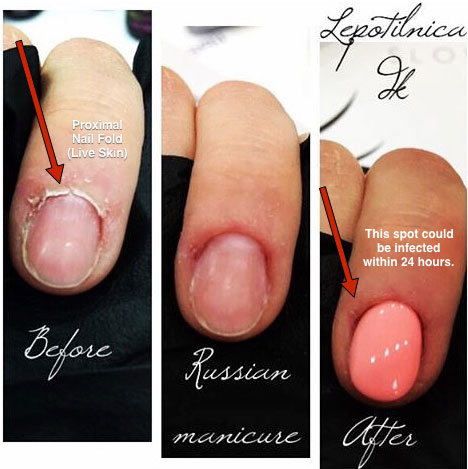
I mean, seriously, that skin looks raw!
In my first post on Russian Manicures, I discussed a couple different Russian Manicure training videos and broke them down step by step.

In this part 2 of my Russian Manicure post, I will present to you what the experts are saying regarding this technique.

Once again, lets remember throughout this that the Eponychium (actually, we now know this should be called the proximal nail fold (PNF)) is living tissue and should never be cut. From the book "Nanotechnology in Dermatology":
"The skin bordering the proximal nail plate is called the eponychium. It does not end at the nail plate, but instead folds back underneath to create a tight seal which prevents pathogens or contaminants form gaining access to the matrix area... [It] serves to help protect and cushion the matrix. This tissue is often mistakenly confused with the cuticle... The cuticle is a vital part of the seal that protects the matrix from pathogenic invasion, which explains why this area should be treated with care when manicuring."
So, what happens when the "Russian manicure" technique is done on a client? Just like with calluses on feet, the more you cut the PNF , the harder than thicker it will grow back trying to protect itself.

Vitaly Solomonoff, founder and president of the Academy of Nail Art and former editor of Nail Spa magazine in Russia, and his colleagues have studied more than 300 cases of people who have had Russian Manicures. They found that 91% of clients who constantly get the Russian manicure have symptoms of the damaged nail matrix or nail bed. "Only 9% of the cases have been determined as safe and “successful” in a long-term period of study (38 months). All 9% of clients have got the manicure from NTs with basic medical education. So, we come to conclusion that deep understanding of the processes in lively skin helps to train the correct technique of this manicure.... Symptoms may not appear right after manicure is performed, the first symptoms occur months after due the constant repetitive traumatization of the cuticle/matrix area. Symptoms include all signs of matrix/nail dystrophy from splitting, horizontal ridges, slow nail grow to the painful neuropathy and high sensitivity. We have also discovered that infectious inflammations are a common issue in those clients who has compromised immune system – diabetics etc....Imperceptible vibration always takes place even with high end e-files and impacts the highly sensitive matrix area and leads to dramatic postponed issues. The technique that may look safe and easy can bring troubles in the future...We strongly believe that micro cracks of the skin are inseminated with bacteria during few hours after the procedure. "

In addition, Solomonoff has said that "The background of the so called 'Russian manicure' is an attempt of e-files distributors to sell their units in Russia. That is why it has been widely advertised as a safe and 'healthy' alternative to clipping the nail cuticles. We, at my company have always stood against this practice unless NT has at least basic medical education and full understanding of Anatomy and Physiology of the nail unit."


Doug Schoon says "Hopefully, this problem may be self-correcting. When those who use these methods start seeing the reported problems associated with these types of manicures, hopefully they'll wake up and smell the coffee. Excessive damage to the skin around the nail plate, excessive regrowth of hardened callus-like tissue, redness, pain, puffiness, weeping/ water-blisters, itching... these are symptoms I'd expect many will see. Not only can this method cause the expected hardening and rapid/excessive regrowth of tissue, the damaged skin is more likely to develop infections. And, product-related skin irritations or allergies are more likely as well. Invaders beware- watch closely for these issues- and don't blame the products- blame your techniques. I'm already hearing of and seeing these problems."

Whatever, My Clients have had No Problems and LOVE the results

The reason your skin feels "softened" after a Russian Manicure is because the electric file wears away layers of  the epidermis - the very layers that work to keep your skin hydrated - and reveal the new, vulnerable skin underneath - often this can even be the dermis layer of the skin, which is not mean to be exposed to the elements.

Remember, you don't have to bleed in order to suffer damage and damage cannot always be seen by the naked eye. An electric file spins at thousands of revolutions a minute. You can be as light handed as you like but you will still cause damage to the natural nail.

Plus it goes against every principle of good nail health and proper technique.

But, other people are doing it!

And if they were all jumping off a cliff, would you do that too?  

Seriously though, here's the thing - if you are in the United States (and many other countries with regulations on the nail industry), the Russian manicure is a technique that is NOT approved by regulatory agencies nor is it covered under insurance company polices (which means a serious financial risk if you perform the service!). Unregulated countries may be 'allowed' to perform this technique ONLY because there are no licensing requirements or regulations. But even if you can so it doesn't mean you should do it.

Educating your clients about the dangers of the technique and encouraging them to share the knowledge with their friends will help reduce the popularity. Yes, there will still be people who "don't care" and will still seek out the service, but for every person we can educate about the dangers, that is one less person seeking out the service and one less person with damaged nails and skin. We do what we can.

What should we be doing instead?

Regular (preferably weekly) manicures using hydroxy acid based exfoliation products and hydrating masks coupled with a good quality cuticle oil twice a day will take a few weeks but you will see a massive improvement without any mechanical intervention.


References:

https://schoonscientific.com/wp-content/uploads/2017/07/May-17-Doug-Schoon-column.pdf
http://www.newnailcreations.com/links
http://www.salongeek.com/threads/russian-manicure-technique.297841/
https://www.nailcarehq.com/russian-manicure-dangerous/
https://www.nailcarehq.com/the-dangers-of-the-russian-manicure/
https://www.facebook.com/athena.elliott1/posts/10210980427719423


Sunday, May 14, 2017

Russian Manicure Part 1 - Video reviews


If a nail trend has ever given me the willies, its the Russian Manicure (a.k.a combined manicure, Korean manicure, machine manicure). The effect is clean and stunning....and almost always not something that is within scope of a nail tech's license. Having said that, I will say that there are certain parts of the technique that are useful and can be done by a well trained nail tech without damage to the client. But there are other parts of the procedure that literally amount to minor surgery. Lets break this down.


First, a side note. Lets remember throughout this that the eponychium is living tissue and should never be cut. From the book "Nanotechnology in Dermatology":
"The skin bordering the proximal nail plate is called the eponychium. It does not end at the nail plate, but instead folds back underneath to create a tight seal which prevents pathogens or contaminants form gaining access to the matrix area... [It] serves to help protect and cushion the matrix. This tissue is often mistakenly confused with the cuticle... The cuticle is a vital part of the seal that protects the matrix from pathogenic invasion, which explains why this area should be treated with care when manicuring."
Back to our regularly scheduled post:


In the first video, they are using a variety of bits to "clean" the cuticle and eponychium.
  • First, a fine small diamond cylinder bit is used to remove visible cuticle stuck the nail plate. This could be okay, as long as the bit is very fine and care is taken to not over file. There is quite a bit of "dust" on the nail when they do this which is nail plate dust. I don't think that bit is very fine.
  • Second, a needle bit with a blunt edge is used and they instruct you to go "as deep as possible" into the nail grooves. My problem here is that they start pushing under the eponychium to "clean" the cuticle - and in the process are breaking the seal that the eponychium gives to the nail matrix.
  • The third bit is a corundum (stone) bit - which is porous and not disinfectable. You would need to use a new bit for every client. They are using it to smooth the nail plate. This is the third time they have gone over the same area around the sidewalls and eponychium of the nail with a rapidly spinning bit. I don't care how soft the bit is, at this point you are starting to take layers of the nail off.
  • Fourth they use a tiny diamond football (or bullet) to go over again to go even more deeply into the nail folds.
  • A round diamond bit is used to clean raised skin (they keep calling it cuticle but its really living tissue). They also use it to file down the hard, dry skin at the corner of the nails. That makes sense to me, its the same as filing calluses on the feet .

Even worse is the video where they do the same manicure but add scissors. They say that there are 2 instances that you need to use scissors - the first is when your client has "damp cuticle" and is too elastic to get with the machine and the second is for new techs who are not comfortable using the round bit.
  • In this video they show a client with healthy eponychium that is a bit overgrown. They first dry out the moist eponychium with baby powder and then push back the stuck eponychium, (again they keep calling it cuticle, which is wrong)
  • They then use the diamond bit to remove cuticle on the nail plate (which they keep calling pterygium, which is also wrong) and to push up under the eponychum that they pushed back in the first step. Their goal is to raise that eponychium off the nail plate in order to be able to grab it with scissors later. They use the same bit along the sidewalls
  • They powder the skin again to dry it and then use a scissors to cut off the raised eponychium., This is the part where I can't help but cringe.
  • Next they are using a corundum (stone) bit to remove the cuticle that is leftover on the nail plate and smooth the nail plate. Again these bits are porous and not disinfectable.
  • They next use the round diamond bit along the edge where they just cut off the eponychium to further raise the skin "for later cleaning" and then file any raised skin off using the same bit as well as filing down any hard skin on the sides of the nail.
  • They use another corundum (stone) bit to smooth the skin around the nail. 
  • Then they push back the eponychium with a pusher again. How much trauma can this finger withstand??
What are your thoughts on these procedures??

Part 2 of Russian Manicures -  the Consequences and Experts Weigh In coming soon!

Monday, October 5, 2015

Waterless Manicures

The very first thing a nail tech learns in school is a basic manicure.  Its pretty easy - shape the nails, soak the nails in warm soapy water, push back cuticles, apply lotion and polish.  This type of manicure has been going on forever! Well, what if I told you that this procedure is the basis for a number of problems that manicurists experience all of the time (from peeling nails to chipped polish and more)?
 
 
Now we all know the basics of nail structure. But how many of us realize that the nail plate isn't a solid structure?  It is made up of a lot of cells that were produced in the matrix and then flattened out into sheets as they grow to form the nail plate. If you were to look closely at the plate (with a microscope) you would see it isn't a solid structure, rather it is full of nooks and crannies - kind of like a sponge.
What happens to a sponge when you immerse it in water?  It fills its nooks and crannies with water and expands.  Depending on the original shape of the sponge, it can even change shape after soaking in water.
 
Now, if you were to coat said sponge in, say, nail polish, while it is still damp, what might happen when the sponge eventually dries out once again (which takes some time)?  At that point the polish is dry and the sponge has shrunk away from the dried coating, causing it to chip.  And the thinner the sponge, the more distorted the difference between wet and dry.
 
Lets look at another analogy. Wood is similar in structure to a nail plate as well, in the fact that it is made up of layers.  What happens to wood when you leave it out in the rain contently?   The repeated wet-expand-dry-shrink cycle causes the wood to split and splinter.
 
 
Do you see where I am going with this???  Repeated expansion and contraction of the nail plate when repeatedly exposed to water causes stress on the plate and eventual weakness, splitting, peeling and chipping polish.   The thinner a clients nails the more the nail will expand and contract causing even more damage (which is also why some people with really hard nails never seem to have problems no matter what they put their hands into!)  Water is classified as a solvent for a reason -  repeated exposure dissolves things (Grand Canyon anyone?).
 
Back in the day when people first started offering manicures as a service, there was not a nail industry.  They did not have a million cuticle removers an lotions and oils available to them so warm soapy water was used to soften the cuticle.  Water is damaging to the natural nail and there is no reason to soak the fingers in water any more. Nowadays we have many preparations that work better than soapy water to soften cuticle and do not swell up and damage the nail plate.  Water based manicures are obsolete technology.
 
Basic Waterless Manicure Procedure
  1. Shape Nails
  2. Apply cuticle remover and push back/detail cuticles
  3. Remove cuticle remover per manufacturers instructions (this may entail having a spray bottle of water at your table but spraying and wiping is vastly different than soaking nails in water).
  4. Apply lotion
  5. Cleanse nails and polish
 
As for clients, they need to do their part at home. 
  • Use gloves when washing dishes or other cleaning chores. 
  • Use a good cuticle oil on the nail plate to help keep it supple (think of cuticle oil as a car wax - it helps keep the elements from soaking into the car/nail). Make sure it is a good natural oil and not mineral oil - mineral oil has too big of a molecule to penetrate the nail plate.
  • After showering or bathing, they need to be gentle with their hands to avoid breaking or chipping a nail that is full of water and weak.


For more information:


Tuesday, September 29, 2015

Common Nail Disorders: Nail Fungus


Onychomycosis/tinea unguium or nail fungus could be indicative of other medical problems or it could have caused complications. Fungus can become systemic (spread throughout the body).People with compromised immune systems (Lupus, HIV, etc) with invasive fungal infection have higher risk of complications and death.

In about one out of two dozen cases, the fungus migrates to other parts of the body, like the hands, back and legs, said Dr. Boni E. Elewski, a professor of dermatology at the University of Alabama at Birmingham who specializes in nail disorders.  For people who have nerve damage and poor circulation -- someone with diabetic neuropathy, for example -- this can have serious consequences. “Podiatrists frequently cite this as a cause of diabetic amputations,” Dr. Elewski said. “The fungus paves the way for bacteria, and it can definitely be a problem.” 

It’s not at all uncommon for patients with toenail fungus to also succumb to athlete’s foot, jock itch, and ringworm. “If your immune system isn’t functioning at its very strongest, the fungus will work against you to open the body up to other attacks,”  Dr. Nadia Levy explains. "The longer you wait, the harder it is to treat"

Dermatologists estimate these fungal infections account for 50% of all nail disorders they treat. Recent studies suggest that as much as 13% of the U.S. population has a fungal infection of one or more nails. As the fungal infection advances, the separated nail appears yellow and opaque, then appears crumbled and can brown.

Aging is the most common risk factor for onychomycosis due to diminished blood circulation, longer exposure to fungi, and nails which grow more slowly and thicken, increasing susceptibility to infection. Nail fungus tends to affect men more often than women, and is associated with a family history of this infection.

Onycholysis is NOT Fungus
Onycholysis refers to the detachment of the nail from the nail bed, usually starting at the tip and/or sides and is often caused by an internal disorder, trauma, infection, or certain drug treatments.

If addressed quickly, this common nail disorder poses no danger to clients. In general, clients should clip the affected portion of the nail and keep the nails short, keep the nail bed dry, avoid exposure to contact irritants, and wear gloves for wet work. The portion of nail that has separated will not reattach to the nail bed, so you will have to wait until the nail is fully regrown for the condition to be completely gone.  It is not recommended that the client have enhancements put on the nail until the onycholysis is gone.

Because the nail is lifted off the nail bed, creating a nice warm "pocket", onycholysis can allow fungus to more easily take root on a nail so it is important to keep an eye on the nail while the onycholysis is growing out.

As a nail technician, know that if you get a client with a nail fungus you must refer them to a doctor for treatment. Giving advice regarding nail fungus could be considered practicing medicine without a license.


References:
http://www.aafp.org/afp/2001/0215/p663.html
http://well.blogs.nytimes.com/2013/10/11/ask-well-leaving-nail-fungus-untreated/?_r=0
http://healingfeet.com/toes-2/danger-leaving-toenail-fungus-untreated#sthash.kT74aPa4.dpuf
http://www.nailsmag.com/article/92526/under-the-microscope-onycholysis
https://en.wikipedia.org/wiki/Onychomycosis

Monday, September 7, 2015

Common Nail Disorders: Powdery white spots under polish

Someone asked me a question about white spots on the nail - not your "normal" Leukonychia - but the kind that is under polish and is almost powdery.
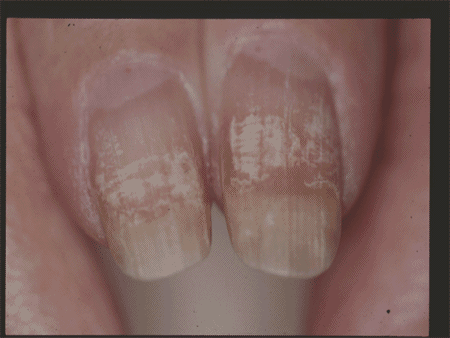
Keratin granulations are the result of excessive dehydration of the keratin molecules that have turned into a chalk like substance on your nail surface; they are completely harmless and are easily corrected with a few weeks of moisturizing treatments. This is the most likely reason for the spots, especially if they appear after removing nail polish.
However, as nail techs, we all also need to be aware of white superficial onychomycosis.
This type of infection is the second most common type of infection you can get that commonly affects the toenails and not the fingernails. The main cause of this type of nail fungus infection is the dermatophyte, Trichophyton mentagrophytes.
This fungus has the unique feature to develop on the top layers of the nail, and eventually spreads on the entire nail-plate.
Initially, tiny white patches appear on the surface of the nail-plate. As the fungus spreads, the nails may dry out and the surface of the nails flake and crumble.
The fungus feeds on the nail protein, keratin, to obtain its nutrients, which further weakens the nail-plate, and makes it distorted. White superficial onychomycosis is spread it is spread like any fungus - unsanitary tools and files for one - but also locker rooms and other places people go barefoot . it's interesting to note that not everyone exposed develops it though, it's a very complex thing
Of course, we are not licensed to diagnose things like this so if there is ANY question, your client should be sent to a doctor.